A self-storage facility is a strange building to maintain. Most of it is unstaffed most of the time. Hundreds of tenants come and go on their own gate codes, often in the evening, dragging furniture down corridors and leaving behind packing debris, dust, and the occasional abandoned sofa. The office is open limited hours. And nobody is walking the building between tours to notice that the third-floor corridor needs sweeping.
The result is a facility where condition degrades quietly and then becomes very visible on exactly the day it matters — when a prospective tenant takes a tour and compares you to the place two miles up the road charging the same rate.
For storage operators across Harrisburg, Camp Hill, Mechanicsburg, Hershey, and Lebanon, a cleaning program handles the parts nobody is there to handle: corridors and elevators, the rental office, restrooms, the gate and entry areas, and the move-out units that have to be rent-ready before they can be listed.
The office is the only part of the facility a prospective tenant looks at closely, and it’s where the lease gets signed.
Document handling: storage offices hold tenant rental agreements, payment records, and contact information. Crews leave paperwork and screens exactly as found and report anything exposed rather than handling it.
This matters enough to state before the rest of the scope, because it’s where a storage operator has real exposure.
Occupied units are private. Their contents are tenant property under a rental agreement, and a cleaning contractor does not enter an occupied unit, open a unit, or touch tenant property. Ever. If a unit is open and unattended, the crew reports it rather than entering.
Vacated units are different, but still governed by the operator. When a tenant moves out, the unit becomes the operator’s to clean and re-rent. But anything left behind is subject to the operator’s own lien and disposal process under its rental agreement and applicable law — not a cleaning crew’s judgment about what looks like trash.
In practice:
A cleaning company that treats a vacated unit as “clear it all out” has misunderstood the arrangement, and the liability lands on the operator rather than the vendor.
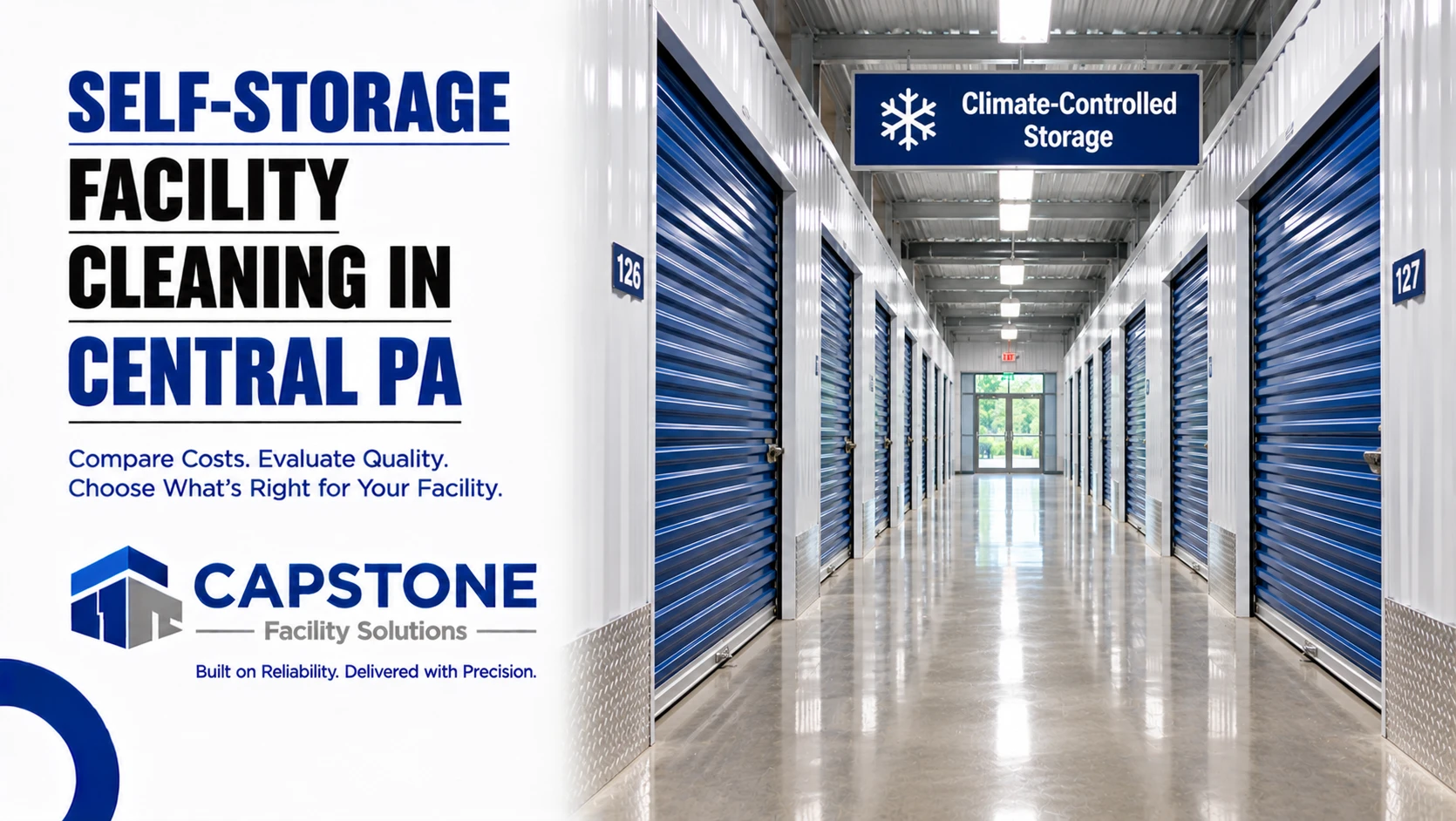
In a multi-story climate-controlled facility, this is the bulk of the square footage and the part tenants actually experience.
Corridor dust is the defining problem. Tenants drag furniture, cardboard, and mattresses through hallways continuously, and the resulting fine dust settles on floors, door bases, and ledges. Without a routine, a climate-controlled corridor looks neglected within weeks even though nothing dramatic has happened.
Carts and dollies are the most-touched shared items in the building and among the least often cleaned.
The hardest-working parts of the building on move-in and move-out days.
Elevator door tracks accumulate packing debris, screws, and grit, which eventually becomes a service call. Clearing them is cheap preventive maintenance disguised as cleaning.
Often the only restroom in the building, used by tenants and staff, and frequently unsupervised.
Tenant-accessible restrooms at an unstaffed facility take unpredictable use with nobody monitoring them — which makes frequency and restocking capacity the deciding factors, as with the public restrooms covered in our municipal building cleaning guide.
This is the recurring project work in a storage contract, and it’s what gets a unit back on the rent roll.
A standard unit turnover covers:
Condition drives the work more than unit size. A unit used for a few months of document storage is a quick sweep. A unit that held furniture for eight years, or that had a moisture problem nobody reported, is a different job. Per-unit pricing should account for condition tiers rather than one flat rate — the same logic as the make-ready turnovers in our apartment community cleaning guide.
Turnovers also cluster. Move-outs concentrate at month end, and a facility may need two units one week and fifteen the next, which means the useful vendor is the one who can scale.
Older and mixed facilities have exterior drive-up units with their own needs.
Scope boundary: snow removal, landscaping, paving repair, and gate mechanical maintenance are separate trades. A cleaning contractor handles debris, litter, and surfaces — not plowing or equipment repair.
The dumpster area deserves a specific mention. Tenants dump what they don’t want to move, and an overflowing dumpster enclosure is the single most common complaint and the fastest way a facility looks poorly run on a tour.
Storage facilities operate differently from almost any other building in this set.
That last point is worth emphasising to operators. At a site nobody visits daily, a cleaning crew is effectively a routine inspection, and the reporting is frequently worth as much as the cleaning.
Smaller facilities often need less frequency than operators expect — a 300-unit single-story site may do well on a weekly visit, while a multi-story climate-controlled building with heavy traffic needs several. The honest answer comes from a walkthrough rather than a formula.
Multi-site operators benefit from one vendor across the portfolio: one consistent standard, one point of contact for the district manager, one insurance file, and capacity that can shift between sites during heavy turnover periods.
Storage is bought on three things: location, price, and what the place looks like when someone walks in. The first two are fixed. The third is a maintenance decision.
Tours convert on condition. A prospective tenant comparing two facilities at similar rates is choosing on whether the corridor is clean, the elevator isn’t full of packing debris, and the restroom is usable. Those are cheap things to get right and expensive things to be wrong about.
Reviews mention it constantly. Storage reviews reference cleanliness, pests, and dumpster conditions more than almost anything else, and prospective tenants read them before driving over.
Vacancy costs more than cleaning. A unit sitting dirty and unlisted earns nothing. Turnover cleaning is one of the clearest cases where a modest per-unit cost protects revenue directly.
Deferred problems get expensive. Elevator tracks full of grit become service calls. Unreported moisture becomes a damaged-goods claim. A crew that walks the building weekly and reports what it sees prevents both.
Capstone Facility Solutions provides commercial cleaning services throughout Central Pennsylvania, including self-storage facilities in Harrisburg, Camp Hill, Mechanicsburg, Hershey, Lebanon, and Palmyra.
We’re clear about the unit boundary. Occupied units are never entered. Vacated units are cleaned only when you release them, and anything left behind is reported rather than discarded unless you’ve given written direction — because the disposal process is yours, not ours.
We work unstaffed sites on a documented access arrangement, keep crews identifiable and consistent, and report what we find: open units, damaged doors, water stains, cut locks, pest evidence. At a facility nobody walks daily, that reporting is part of the value.
For multi-site operators we run one standard across the portfolio with a single local point of contact, and we can scale turnover capacity around month-end clusters.
Every team member is background-checked, and we carry general liability and workers’ compensation coverage with certificates provided on request. All work is backed by our 100% satisfaction guarantee, with no long-term contract required. See our full janitorial services programs.
Most operators contract a commercial cleaning company for corridors, elevators, stairwells, the rental office, restrooms, loading areas, and exterior debris, plus move-out unit turnovers. Many facilities are unstaffed outside office hours, so the work happens on a gate-code or key-access arrangement.
It depends on size and traffic. A smaller single-story facility may do well on a weekly visit, while a multi-story climate-controlled building with heavy traffic typically needs several times weekly, with monthly high dusting and detailed corridor work.
Complete floor sweeping and vacuuming including corners, dust and cobweb removal from walls and ceilings, wall wipe-down, door track and threshold cleaning, interior door cleaning, and removal of tape and adhesive residue — plus reporting of damage, moisture, or pest evidence.
They are reported to the operator, not discarded. Abandoned property is governed by the operator’s lien and disposal process under its rental agreement and applicable law, so a cleaning crew does not make disposal decisions without written direction.
No. Occupied units are private and their contents are tenant property. A cleaning contractor never enters or opens an occupied unit. If a unit is found open and unattended, it’s reported rather than entered.
Yes. Most storage facilities are unstaffed outside limited office hours, so cleaning runs on a documented gate-code or key-access arrangement with identifiable, consistent crews.
Per unit, based on size and condition, usually with condition tiers rather than a single flat rate. A unit used briefly for documents is a very different job from one that held furniture for years.
No. Pest treatment, mold remediation, and biohazard cleanup are licensed specialist trades. A cleaning crew reports evidence of pests, moisture, or anything beyond ordinary cleaning so the operator can bring in the right contractor.
Facility size, construction, and traffic make a big difference to the right frequency — and a walkthrough gives an honest answer rather than a formula.
Call Capstone Facility Solutions at 717-298-7157 to schedule a free assessment for one facility or a portfolio.
Tell us about your facility and we will send a custom, no-obligation price — usually within a day.