A pharmacy and an urgent care clinic share something unusual: both are healthcare settings that behave like retail. Nobody books an appointment. People walk in sick, often with children, sometimes in numbers nobody predicted, and they arrive from early morning until late evening every day of the week.
That changes the cleaning problem in two ways. There’s no reliable closed window — a clinic that runs to 8pm seven days a week doesn’t offer the empty overnight building most commercial cleaning assumes. And both buildings contain areas a cleaning contractor should not be in: the dispensing side of a pharmacy counter, and the clinical surfaces a clinic’s own staff disinfect between patients.
For pharmacies and urgent care clinics across Harrisburg, Camp Hill, Mechanicsburg, Hershey, and Lebanon, a workable cleaning program is one that fits the hours and respects both lines.
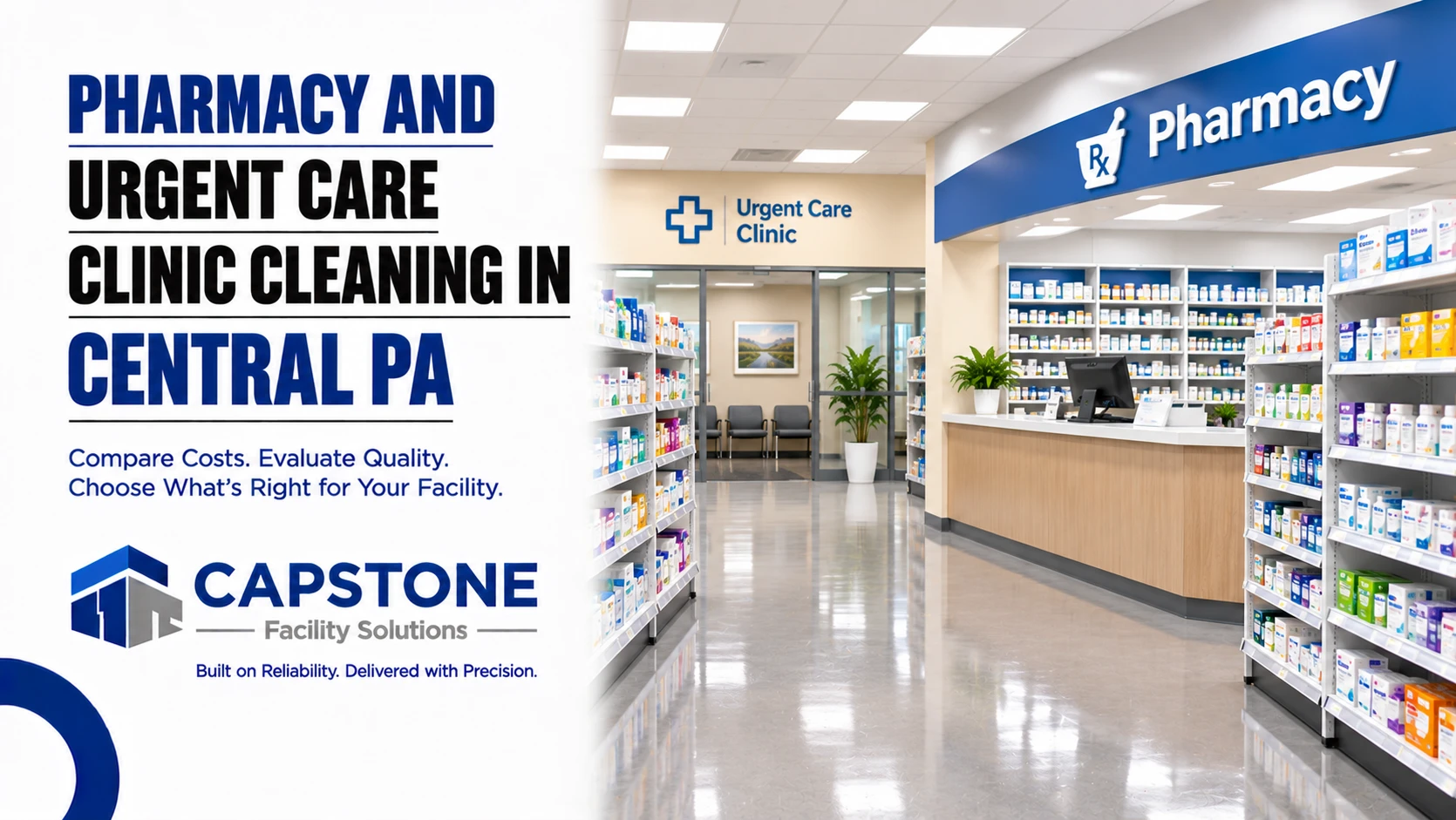
The front of a pharmacy is a retail store, and it’s judged like one.
Retail shelf edges are the most commonly missed item in a pharmacy and the most visible under store lighting — dust on a shelf edge at eye level reads as neglect in a building people associate with hygiene.
This is the first thing a pharmacist-in-charge will want settled.
The dispensing area, compounding spaces, and drug storage are restricted. They hold controlled substances, patient prescription records, and medication inventory, and access is governed by the pharmacy’s own policies under state board of pharmacy rules.
In practice:
A cleaning company that treats the dispensing area as ordinary scope has misunderstood the building. The right approach is to ask at the walkthrough exactly where the line sits and treat the answer as fixed.
The same applies to the drive-thru window interior and any area the pharmacy designates as restricted.
Urgent care waiting rooms hold sick people in close quarters, often for a while, with continuous turnover and no appointment spacing.
Frequency carries more weight here than in a scheduled practice. A waiting room that filled unexpectedly at 3pm needs attention before 7pm, not at 10pm — which is why many clinics add day porter coverage for restroom checks, waiting-room resets, and spill response during open hours. Our post on keeping medical waiting rooms clean between patient visits covers the principle in more depth.
Clinical staff disinfect exam surfaces between every patient as part of the clinic’s own protocol. The cleaning program handles the thorough environmental work around that.
Scope boundary: clinical contact-surface disinfection between patients, instrument handling, sharps containers, and regulated medical waste remain with trained clinical staff under the clinic’s protocol. A cleaning contractor handles environmental surfaces and general waste.
Technique matters as much as scope: EPA-registered disinfectants only work if the surface stays visibly wet for the labelled contact time. A wipe that dries in ten seconds hasn’t disinfected anything.
Both settings put heavy, unpredictable demand on restrooms, and in urgent care the users are frequently unwell.
Restocking frequency is the variable that decides whether a clinic restroom holds up through a busy evening. A single overnight restock doesn’t survive a day that saw a hundred walk-ins.
Both settings handle patient information in administrative areas, so crews should be briefed on the same confidentiality expectations that apply in any medical office — leave paperwork and screens exactly as found, and report rather than handle anything exposed.
Both buildings concentrate shared touch points in ways a typical office doesn’t:
In a building where the visitors are disproportionately sick, consistent disinfection of these points with correct contact times is basic infection control rather than presentation.
Pharmacy retail aisles wear in concentrated traffic lanes between the door and the pickup counter, and entry areas take the worst of Central PA winters — relevant to both appearance and slip risk in a building serving elderly and unwell visitors, as covered in our guide to winter commercial cleaning.
This is the practical obstacle, and the reason many clinics struggle to find a workable vendor.
Pharmacies have their own pattern: retail hours are long, but the dispensing area may be staffed on a different schedule, which affects when any permitted access can happen.
The requirement in both cases is a vendor who can hold a late-evening, seven-day schedule. A clinic that gets missed on a Sunday has a waiting room full of people on Monday morning looking at yesterday’s floor.
Patients are already anxious. People in an urgent care waiting room are unwell, often worried, sometimes with a sick child. The condition of the room feeds directly into whether they feel they’re in competent hands.
Nobody chose this location in advance. Unlike a physician’s practice with established patients, urgent care and pharmacy visits are frequently decided in the moment, and often on reviews read in a parking lot. Cleanliness appears in those reviews constantly.
Infection control is the visible promise. A building full of sick people that visibly isn’t clean undermines the one thing a healthcare setting is assumed to have handled.
Retail competition is direct. A pharmacy is competing against a chain a mile away with the same inventory. Store condition is one of the few things that differentiates it.
Capstone Facility Solutions provides commercial cleaning services throughout Central Pennsylvania, including pharmacies, urgent care clinics, and walk-in medical facilities in Harrisburg, Camp Hill, Mechanicsburg, Hershey, Lebanon, and Palmyra. We also serve physician practices and dental offices across the region — see our medical office cleaning programs.
We schedule around your actual hours, including late-evening and weekend work, and we’ll tell you honestly what we can commit to rather than promising a window we can’t hold. We work within your protocols and product specifications, and we observe labelled contact times rather than wiping and moving on.
We’re clear about boundaries. The dispensing area is entered only as your pharmacist-in-charge authorises, and clinical contact-surface disinfection, sharps, and regulated medical waste stay with your clinical staff. We handle the environment.
For multi-location operators, we can run one consistent standard across every site with a single local point of contact. Every team member is background-checked, and we carry general liability and workers’ compensation coverage with certificates provided on request.
All work is backed by our 100% satisfaction guarantee, with no long-term contract required. See our full janitorial services programs.
Retail floors and aisles, shelving edges and displays, entry glass and matting, pickup and consultation counters, waiting seating, kiosks and self-service equipment, restrooms, staff areas, and trash removal — plus periodic high dusting and floor care. The dispensing area is handled separately, as a restricted area.
Only as the pharmacist-in-charge authorises, and in many pharmacies not at all. Where access is permitted it’s typically limited to floors and trash, often escorted, and nothing is touched — no medication, stock, records, or equipment. Controlled substance storage is never entered.
Most clinics need full cleaning after close, seven days a week given weekend operation, plus daytime attention to restrooms and waiting areas during open hours. Weekly detail work, monthly high dusting, and periodic floor projects complete the program.
Clinical staff disinfect exam surfaces between every patient under the clinic’s protocol. The cleaning program handles the environmental work — floors, cabinet exteriors, non-clinical counters, walls, vents, door hardware, and general waste.
Yes, with a start time set around the actual close. The practical requirement is a vendor who can hold a late-evening, seven-day schedule rather than a fixed weeknight window.
No. Sharps containers and regulated medical waste remain the responsibility of trained clinical staff and the facility’s licensed waste vendor. The cleaning program handles general waste only.
Yes. Multi-location programs give one consistent standard, one point of contact, and one insurance file. Most operators start with one or two sites and expand once the vendor is proven.
EPA-registered disinfectants used according to label instructions, including the required contact time, and selected to match the facility’s own protocol where it specifies products.
Every pharmacy and clinic draws the restricted-area line differently and runs its own hours. A walkthrough settles the scope, the schedule, and the access arrangements in one visit.
Call Capstone Facility Solutions at 717-298-7157 to schedule a free assessment for one location or your whole group.
Tell us about your facility and we will send a custom, no-obligation price — usually within a day.