
A borough building is several different buildings at once. There’s an office side where staff work normal hours, a public counter where residents pay bills and pull permits, council chambers used a few evenings a month, public restrooms open to anyone who walks in, and frequently a community room rented out most weekends. Some municipalities add a public works garage, a police station, a fire hall, or a senior center to the same contract.
That mix is what makes municipal cleaning different from commercial work. The scope spans an office, a retail-style public space, a vehicle garage, and an event venue — and it’s paid for by taxpayers, which means it’s awarded on a written specification and judged against it.
For boroughs, townships, and public facilities across Harrisburg, Hershey, Lebanon, Palmyra, and the surrounding municipalities, the vendor question is less about whether a company can clean and more about whether it can bid properly, carry the right insurance, and perform consistently against a document.
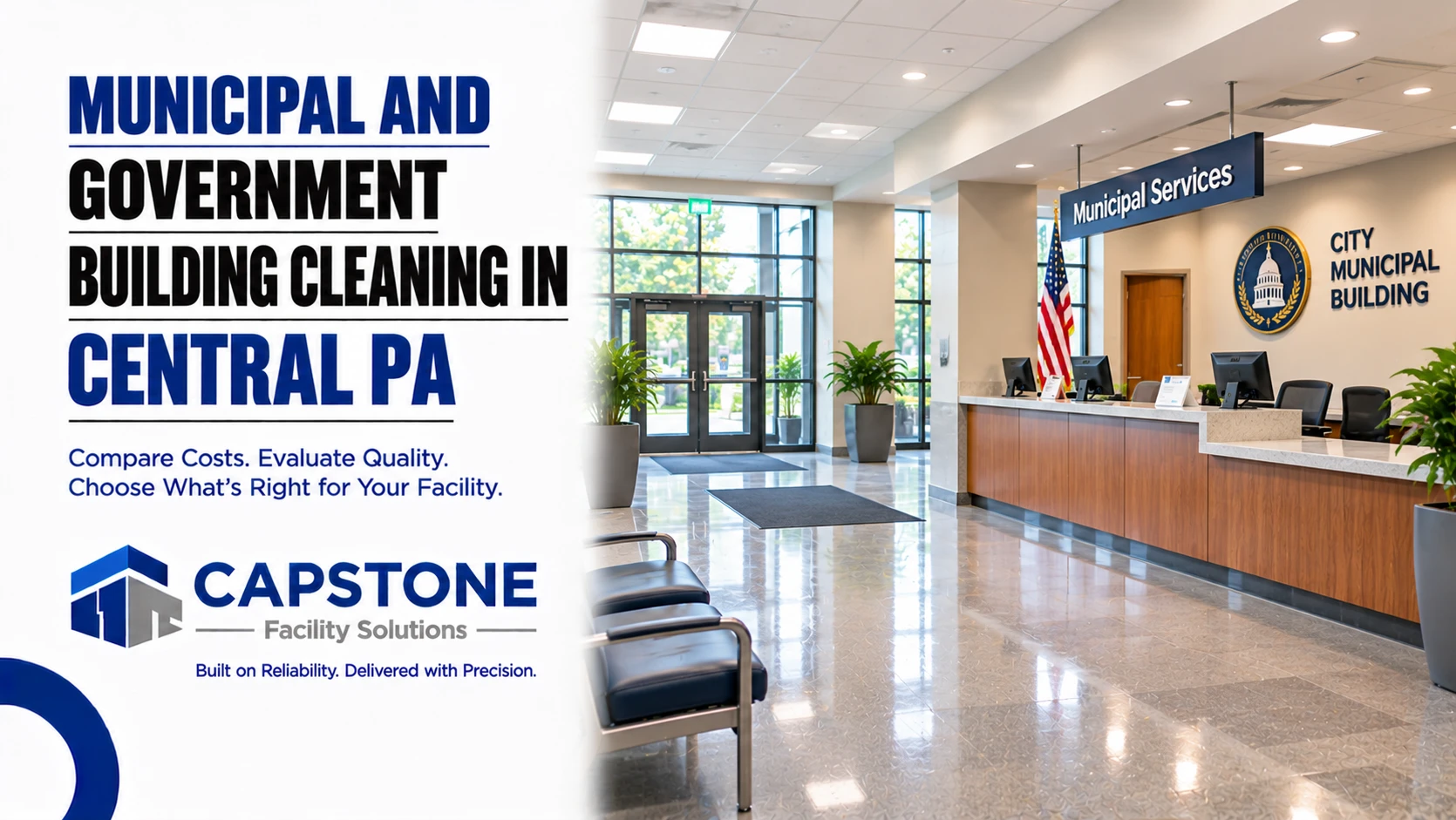
The administrative core of a borough or township building operates like a professional office with a retail front.
Document handling matters here as in any records-holding office. Municipal offices hold permits, tax records, and resident files. Crews leave paperwork and screens exactly as found and report anything exposed rather than handling it — the same discipline covered in our guide to law firm and professional office cleaning.
Used intermittently but highly visible when used, often recorded or livestreamed, and attended by residents.
Chambers typically need attention before each meeting rather than on a flat weekly schedule, since the room may sit unused for three weeks and then host a packed hearing. Meeting calendars are public, which makes this easy to plan around.
Public restrooms are the hardest part of a municipal contract and the most common source of complaints to a borough office.
Unattended public access is the defining challenge. Unlike a private office restroom used by known staff, a public restroom gets unpredictable traffic, heavier wear, and occasional vandalism. Frequency and restocking capacity decide whether it holds up, and many municipalities add midday attention during open hours — effectively day porter coverage scaled to a small building.
Restrooms in parks buildings, pools, and recreation facilities are a separate seasonal scope worth pricing explicitly rather than folding into the main contract.
Many municipalities rent community rooms for parties, meetings, classes, and local events — which makes part of the contract event-turnover work.
This overlaps directly with the turnaround work covered in our post on event venue and banquet cleaning. The practical difference is that municipal rentals cluster on weekends and the room often has to be ready for a Monday-morning public use, which means the turn can’t wait.
Rental schedules are usually known in advance through the municipality’s booking system, so this is plannable — but it needs a vendor who can work weekends.
A public works building is closer to an industrial facility than an office.
Scope boundary: vehicle and equipment cleaning, fluid handling, hazardous or regulated waste, and anything requiring equipment to be locked out stay with municipal staff under the department’s own procedures. A cleaning contractor handles the environment — the same line drawn in our manufacturing plant cleaning guide.
Winter is the hard season here. Salt, brine, and road grime track through a public works building continuously from the first storm to the last, and the floors show it.
These need the most careful scoping, and the agency defines every boundary.
Typical contractor scope covers public lobbies and entries, administrative offices, meeting and training rooms, break rooms, locker rooms, restrooms, and common corridors.
Restricted areas are set entirely by the agency — evidence storage, holding areas, dispatch and communications rooms, armories, and any secure space. These are entered only as the agency authorises, often escorted, and in many cases not at all. Access procedures, background requirements, and escort arrangements are the agency’s to specify, and a contractor follows them exactly.
Fire halls add apparatus bays, which are cleaned around equipment that must remain ready for immediate response — meaning nothing is ever moved, blocked, or obstructed.
Crews working in these facilities should expect enhanced background screening and agency-specific onboarding before a first shift.
Library materials are never moved or reshelved. Dusting is limited to shelf ends, exteriors, and surfaces — books, media, and displays stay where staff put them.
Senior centers see concentrated daily use with meal programs and activities, which means dining-area cleaning on a schedule closer to a cafeteria than an office.
This is where a prepared vendor separates itself, and it’s worth understanding before bidding.
Municipal work is generally awarded against a written specification rather than a conversation. A typical bid package includes:
What a municipality typically expects from a bidder:
Prevailing wage deserves attention. Some public contracts in Pennsylvania carry prevailing wage obligations, which affect labour cost and require specific payroll documentation. Whether it applies depends on the contract, and the requirement will be stated in the bid package — but it changes pricing materially, so it’s something to confirm before bidding rather than discover afterward. A contractor unfamiliar with it will either underbid and lose money or be found non-compliant.
Public meetings are an underused research tool. Municipal agendas and minutes are public, and contract renewals, facility issues, and upcoming bids appear in them well before a formal solicitation. A local contractor who follows the agendas in a few townships sees the work coming.
A single municipal contract may need four different schedules.
The practical requirement is flexibility across facility types within one agreement, and a vendor who can hold a weekend commitment. Municipal staff are a small team; if the community room isn’t turned by Monday, there’s nobody to absorb it.
They belong to the residents. A borough hall is a civic building that people visit to pay taxes, attend a hearing, or get a permit. Its condition reflects on the municipality in a way a private office’s doesn’t, and residents say so at public meetings.
Public access means heavier and less predictable use. Restrooms, lobbies, and counters take traffic from anyone who walks in, with no corporate norms moderating it.
It’s visible accountability. Facility condition appears in budget discussions, resident complaints, and council meetings. A clean building is quietly one less agenda item.
Safety in public spaces carries liability. Wet entries and slick floors in a building open to the public — including many elderly visitors — are a direct exposure for the municipality, which makes winter entry management more than cosmetic. Our guide to winter commercial cleaning covers the salt and matting side in detail.
Capstone Facility Solutions provides commercial cleaning services throughout Central Pennsylvania, including municipal buildings, community centers, and public facilities in Harrisburg, Hershey, Lebanon, Palmyra, and surrounding municipalities.
We’re locally owned and based in Palmyra, which matters for public work in a practical way: the person who walks your building and writes the response is the person you call when the community room needs turning on a Sunday. There’s no regional dispatch line between a borough manager and a decision.
We work from your written specification rather than our own checklist, and we build schedules that handle a mixed facility — offices nightly, chambers before meetings, restrooms daily, rentals on weekends. Where a facility sets restricted areas or enhanced screening requirements, those are yours to define and ours to follow exactly.
Every team member is background-checked, and we carry general liability and workers’ compensation coverage with certificates provided to your requirements. All work is backed by our 100% satisfaction guarantee. See our full janitorial services programs, or read what to look for in a cleaning contract and scope of work.
Usually through a written bid or quote process against a published specification covering scope by area and frequency, insurance requirements, term length, and submission format. Awards may go to the lowest responsible bid or follow a broader evaluation, depending on the municipality and contract value.
A detailed scope of work by area and frequency, facility inventory and square footage, required insurance types and limits, any bonding requirement, term and renewal options, submission deadlines and format, and evaluation criteria.
Some do. Whether it applies depends on the specific contract, and the requirement will be stated in the bid package. It affects labour cost and requires certified payroll documentation, so it should be confirmed before bidding rather than discovered afterward.
A cleaning contractor typically handles the environment — shop floors, degreasing, break and locker rooms, restrooms, offices, and trash. Vehicle and equipment cleaning, fluid handling, and regulated waste stay with municipal staff under the department’s own procedures.
Yes, in public and administrative areas. Restricted areas such as evidence storage, holding areas, dispatch, and secure spaces are defined entirely by the agency and entered only as it authorises. Enhanced background screening and agency onboarding are typically required.
Post-event turnover is commonly part of the municipal cleaning scope — room reset, table and chair handling, floors, kitchen areas, restrooms, and trash. Rentals cluster on weekends, and the room usually has to be ready for Monday-morning public use.
Daily cleaning, disinfection, and restocking at minimum, with midday attention during open hours in busier buildings. Unattended public access means heavier and less predictable use than a private office restroom.
No. In library facilities, dusting is limited to shelf ends, exteriors, and surfaces. Books, media, and displays are never moved or reshelved by cleaning staff.
Every municipality combines facilities differently, and the right scope depends on which buildings are in the contract and how the community room gets used.
Call Capstone Facility Solutions at 717-298-7157 to schedule a walkthrough — or send us your bid specification and we’ll respond to it as written.
Tell us about your facility and we will send a custom, no-obligation price — usually within a day.