VCT flooring doesn’t fail suddenly. It goes dull, then slightly yellow, then picks up a grey cast in the traffic lanes that no amount of mopping touches. By the time someone says “the floors look bad,” what they’re actually looking at is years of finish that has worn thin in some places and built up dirty in others.
Mopping can’t fix that, and neither can buffing. The old finish has to come off and new finish has to go down — which is what strip and wax means.
For businesses across Harrisburg, Hershey, Lebanon, and Palmyra running VCT in offices, medical practices, schools, dealerships, and retail spaces, refinishing is the periodic project that resets the floor and protects the tile underneath. Done on schedule, it’s routine maintenance. Left too long, it stops being a cleaning job and becomes a flooring replacement quote.
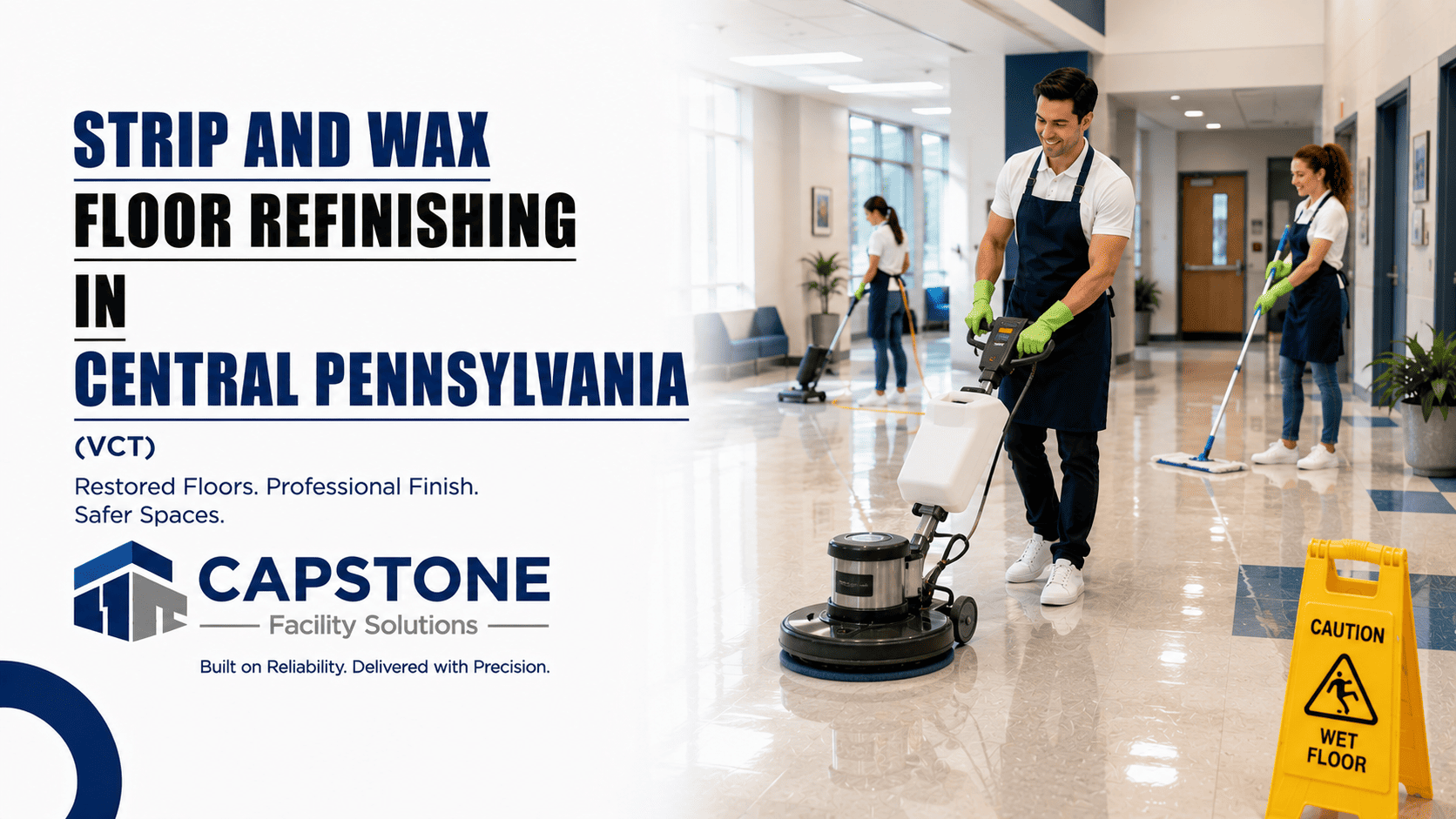
The terminology is a holdover — modern “wax” is an acrylic floor finish, not wax. But the name stuck, and it describes a complete removal-and-rebuild of the protective coating on a hard floor.
The finish is a sacrificial layer. It takes the abuse — scuffs, scratches, cart wheels, grit — so the tile underneath doesn’t. Over time that layer wears down in traffic lanes and builds up dirty at the edges, and once it’s degraded past a certain point, adding more finish on top just seals the problem in.
Stripping removes everything down to bare tile. New sealer and finish then go back down in coats. The result is a floor that looks new, protects the tile again, and resets the maintenance clock.
A proper strip and wax is a multi-hour project with cure time built in. Skipping steps is where bad results come from.
Frequency depends on traffic, not on a calendar rule. Over-stripping is a real problem — every strip removes a small amount of tile along with the finish, so doing it more often than needed shortens the floor’s life.
Scrub and recoat— also called a top scrub — removes the top layer of finish only and adds fresh coats. It’s cheaper, faster, and far less disruptive than a full strip, and running it between strips can double the interval before a full strip is needed. Most buildings should be doing more recoats and fewer strips than they actually are
Distinguishing “needs a strip” from “needs a recoat” saves real money:
Full strip needed:
Recoat likely sufficient:
The distinction is discolouration. Dull-but-clean is a recoat. Grey, yellow, or built-up is a strip.
This is project work that closes an area for a working day or more, so scheduling drives everything.
Most buildings don’t do the whole floor at once. Zoning it — corridors one night, open areas the next — keeps the building usable and is usually the more practical approach even when a full shutdown is available.
Strip and wax is quoted per square foot, and the range is wide because condition varies enormously.
A properly done strip and wax lasts as long as the maintenance behind it allows. The same floor can look good for two years or degrade in six months depending entirely on what happens after the crew leaves.
Getting the daily side right is what makes the periodic side affordable. If a building is stripping annually when it should be stripping every two years, the fix is usually matting and the right cleaner, not more frequent projects.
Strip and wax applies to specific flooring types, and applying it to the wrong surface causes damage.
Not suitable:
Any contractor who proposes stripping and waxing LVT without checking the manufacturer’s specification is a problem. It’s an increasingly common error as LVT replaces VCT in commercial buildings.
Refinishing gets deferred because it’s a visible line item that competes with things that feel more urgent. But the arithmetic works against deferring it.
The finish exists to protect the tile. Once it’s gone in the traffic lanes, wear moves to the tile itself — and tile damage isn’t reversible by cleaning. A floor that could have been maintained for years becomes a replacement project costing many times what refinishing would have.
There’s a presentation dimension as well. Floors are one of the largest visible surfaces in any building, and a dull, discoloured floor reads as neglect regardless of how clean everything else is. In customer-facing spaces — dealership showrooms, medical waiting rooms, retail floors, building lobbies — that impression is doing work every day.
We assess the floor before quoting rather than pricing from square footage alone, because condition is what actually determines the work involved — and we’ll tell you when a scrub and recoat will do the job instead of a full strip. We schedule around your operations, working overnight, weekends, or zone by zone, and we advise on the daily maintenance that determines how long the result lasts.
All work is backed by our 100% satisfaction guarantee, with no long-term contract required.
Strip and wax is the complete removal of old floor finish from a hard floor, followed by application of new sealer and finish coats. Despite the name, modern commercial “wax” is an acrylic floor finish rather than actual wax.
Most commercial VCT is stripped every 12 to 24 months depending on traffic, with scrub-and-recoat service in between. Schools typically strip annually over summer break. Over-stripping shortens tile life, so recoating between strips is usually the better approach.
Pricing is per square foot and varies widely based on floor condition, layout complexity, number of coats, furniture moving, and scheduling. A floor with years of buildup may need multiple stripping passes, which changes the quote significantly. A walkthrough gives an accurate number.
A typical area takes a full working day including stripping, rinsing, drying, and multiple finish coats with drying time between each. The floor is walkable within hours of the final coat, but full cure takes longer, and heavy traffic or furniture should be kept off until then.
Stripping removes all existing finish down to bare tile and rebuilds it. Buffing or burnishing restores gloss to existing finish without removing it. Buffing is routine maintenance; stripping is a periodic project.
Yes — a scrub and recoat removes only the top layer of finish and applies fresh coats. It works well when the floor is dull but not discoloured, and it’s cheaper and less disruptive. Once there’s grey or yellow discolouration or visible buildup, a full strip is needed.
Usually not. Most LVT is manufactured with a factory-applied wear layer and is not designed to be waxed — applying finish can void the warranty. Always check the manufacturer’s maintenance specification before treating LVT.
Yellowing usually comes from finish buildup in low-traffic areas where the coating accumulates over repeated recoats without stripping, or from using the wrong cleaning chemistry. It’s a sign the floor is due for a full strip rather than another recoat.
Floor condition varies more than square footage does, which is why refinishing quotes should come from an on-site look rather than a phone estimate — and why sometimes the honest answer is a recoat rather than a full strip.
Call Capstone Facility Solutions at 717-298-7157 to schedule a free floor assessment and get a refinishing quote and recommended maintenance schedule for your building.
Tell us about your facility and we will send a custom, no-obligation price — usually within a day.