Every commercial cleaning contract involves trusting a crew with after-hours access to your building. In a law firm or accounting practice, that crew is also moving nightly past privileged case files, client financial records, open matters on desks, and screens that someone forgot to lock.
That makes the cleaning conversation different. Thoroughness matters — these are client-facing offices where presentation is part of the professional product — but what a managing partner or office manager actually wants to know first is simpler: who are these people, what are they trained not to touch, and what happens to what they see.
For law firms, CPA practices, title companies, and financial advisory offices across Harrisburg, Camp Hill, Mechanicsburg, Hershey, and Lebanon, a good cleaning program answers those questions before it talks about floors.
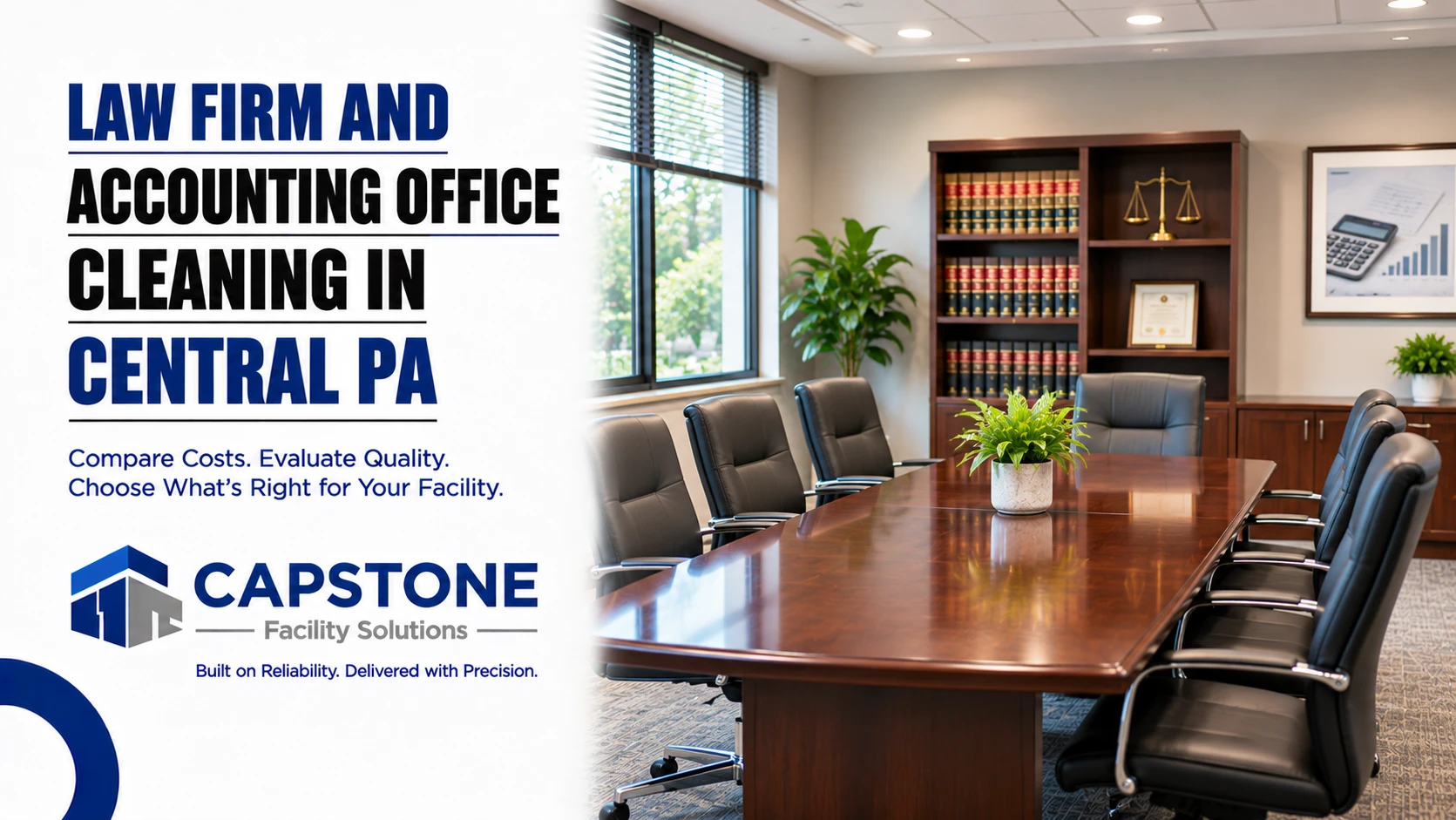
Reception is where a client forms an impression before meeting anyone, and in professional services that impression is part of what they’re paying for.
A dusty reception in a firm charging professional rates reads as inattention, fairly or not. It’s the lowest-cost, highest-visibility part of the scope.
This is the part that matters most, and the part most cleaning companies never address.
What a cleaning crew does not do:
Shred bins and secure containers are not the cleaning crew’s responsibility. They’re handled by the firm’s own document destruction vendor under a chain-of-custody arrangement. A cleaning company that offers to empty them has misunderstood the obligation, and that offer should be a disqualifier.
What happens when something is left exposed: it gets reported to the firm’s contact, not handled. A file left open on a conference table, a document on a printer, a cabinet left unlocked — the crew notes it and tells someone. That’s useful to a firm; a crew that “helpfully” filed it away is not.
Crews working in professional offices should be briefed on confidentiality before their first shift, and firms frequently require a signed confidentiality agreement as part of vendor onboarding. Any vendor hesitant about signing one shouldn’t be working in a law office.
Conference rooms host client meetings, depositions, closings, and signings — often first thing in the morning.
Conference tables deserve particular care. Many are high-end wood or stone, and the wrong product dulls or marks a surface that sits directly in a client’s eyeline. The finish determines the product, and a firm should expect a vendor to ask.
Rooms also need to be reset to a standard configuration rather than left as the last meeting ended — a detail worth writing into the scope.
Private offices hold the most sensitive material in the building, which narrows what cleaning covers.
The operating rule is simple: clean around the work, not through it. Desks with active matters are left exactly as found. Many firms specify that partner offices get a limited scope — trash and floors only — and that’s a legitimate arrangement worth asking about at the walkthrough rather than assuming.
Many firms restrict these entirely, and the scope should say which applies.
Where access is permitted:
Where it isn’t, the room is simply excluded. Nothing is removed from shelves, no boxes or files are opened or moved, and the crew doesn’t enter unaccompanied if the firm requires otherwise.
Support staff areas combine heavy paper handling with high-touch equipment.
Printer and copier areas accumulate paper dust more than people expect, and it migrates onto nearby surfaces — worth being on the schedule rather than handled occasionally.
Client restrooms get the reception standard. Staff restrooms and breakrooms matter for a different reason — these are long-hours professions, and the breakroom gets heavy use, particularly in a CPA office in March.
Professional offices tend toward finishes that need specific care.
Carpet in corridors and reception wears in concentrated traffic lanes and shows it early. A scheduled extraction cycle, handled through commercial floor care, is what keeps a professional office from looking tired between refurbishments.
Professional offices run long days, with lawyers and accountants frequently in the building late.
Busy season deserves its own plan. CPA practices run January through mid-April at full capacity, with extended hours, weekend work, temporary staff, and heavier breakroom and restroom use. The sensible pattern is an increased scope through those months, then a return to baseline — with the deep work (carpet extraction, floor refinishing, detailed restroom projects) scheduled for the quieter summer, when it won’t be immediately undone.
Law firms have their own peaks around trial calendars and major closings, which are worth asking about rather than assuming a flat year.
Firms that handle privileged material should expect, at minimum:
The subcontracting question is the one most often skipped and most likely to surprise. If it matters that the company you vetted is the company in your building at 9pm, it needs to be in writing. Our guide to what a cleaning contract should include covers the rest of the agreement.
Capstone Facility Solutions provides commercial cleaning services throughout Central Pennsylvania, including law firms, CPA practices, title companies, and financial advisory offices in Harrisburg, Camp Hill, Mechanicsburg, Hershey, Lebanon, Palmyra, and surrounding communities.
Our crews are briefed on confidentiality before their first shift and trained to clean around the work rather than through it: papers aren’t moved, files aren’t opened, screens aren’t touched, and shred bins stay with your document destruction vendor. Anything left exposed is reported to your contact, not handled.
Every team member is background-checked, we keep crews consistent so your staff know who’s in the building, and we’re glad to sign your confidentiality agreement as part of vendor onboarding. We carry general liability and workers’ compensation coverage with certificates provided on request.
We’re locally owned, so the person who quotes your office is the person you reach — not a national dispatch line. We also adjust scope for busy season rather than running the same program in March as in July.
All work is backed by our 100% satisfaction guarantee, with no long-term contract required. See our full janitorial services programs.
By not handling them. Crews don’t move, stack, read, photograph, or discard documents, don’t open files or cabinets, and don’t interact with computer screens. Anything left exposed is reported to the firm’s contact rather than dealt with by the crew.
No. Shred bins and secure document containers are handled by the firm’s own document destruction vendor under a chain-of-custody arrangement. A cleaning company offering to empty them has misunderstood the obligation.
Yes. Professional firms commonly require confidentiality agreements as part of vendor onboarding, and Capstone Facility Solutions signs them.
Yes. All team members are background-checked before working in any facility, with documentation available. In professional offices this matters particularly, since crews have after-hours access to privileged material.
Most professional offices are cleaned nightly after close, with weekly detail work on conference rooms and glass, monthly high dusting, and periodic carpet and floor projects. CPA practices typically increase scope through busy season and return to baseline afterward.
Yes. Professional offices often have staff working late, so start times are set around the firm’s actual hours rather than a fixed schedule — sometimes 9pm or later.
Some can, particularly franchise operations. If the contract is silent on subcontracting, ask directly — it determines whether the crew in your building is employed by the company you actually vetted.
Many firms restrict these to a limited scope — trash and floors only — or exclude them entirely. That should be settled at the walkthrough and written into the scope rather than left to assumption.
Every firm draws the line differently on restricted areas, partner offices, and file storage. A walkthrough settles the scope and the schedule in one visit.
Call Capstone Facility Solutions at 717-298-7157 to schedule a free assessment for your office.
Tell us about your facility and we will send a custom, no-obligation price — usually within a day.