Most commercial cleaning runs on a schedule. Event cleaning runs on a deadline.
A wedding ends at eleven, the room has to be reset by noon for a Sunday brunch, and there’s no version where that slips. Cake on the carpet, spilled bar service, four hundred place settings to clear, decor a vendor left behind, and a floor that needs to be genuinely clean before anyone walks in for the next booking. The work isn’t harder than office cleaning — it’s compressed, and it happens at hours when finding reliable help is hardest.
For banquet halls, wedding venues, conference facilities, country clubs, and hotels across Harrisburg, Hershey, Lebanon, and Palmyra, a cleaning partner who can work overnight and hit a hard turnaround is worth more than one who can clean thoroughly on a comfortable timeline.
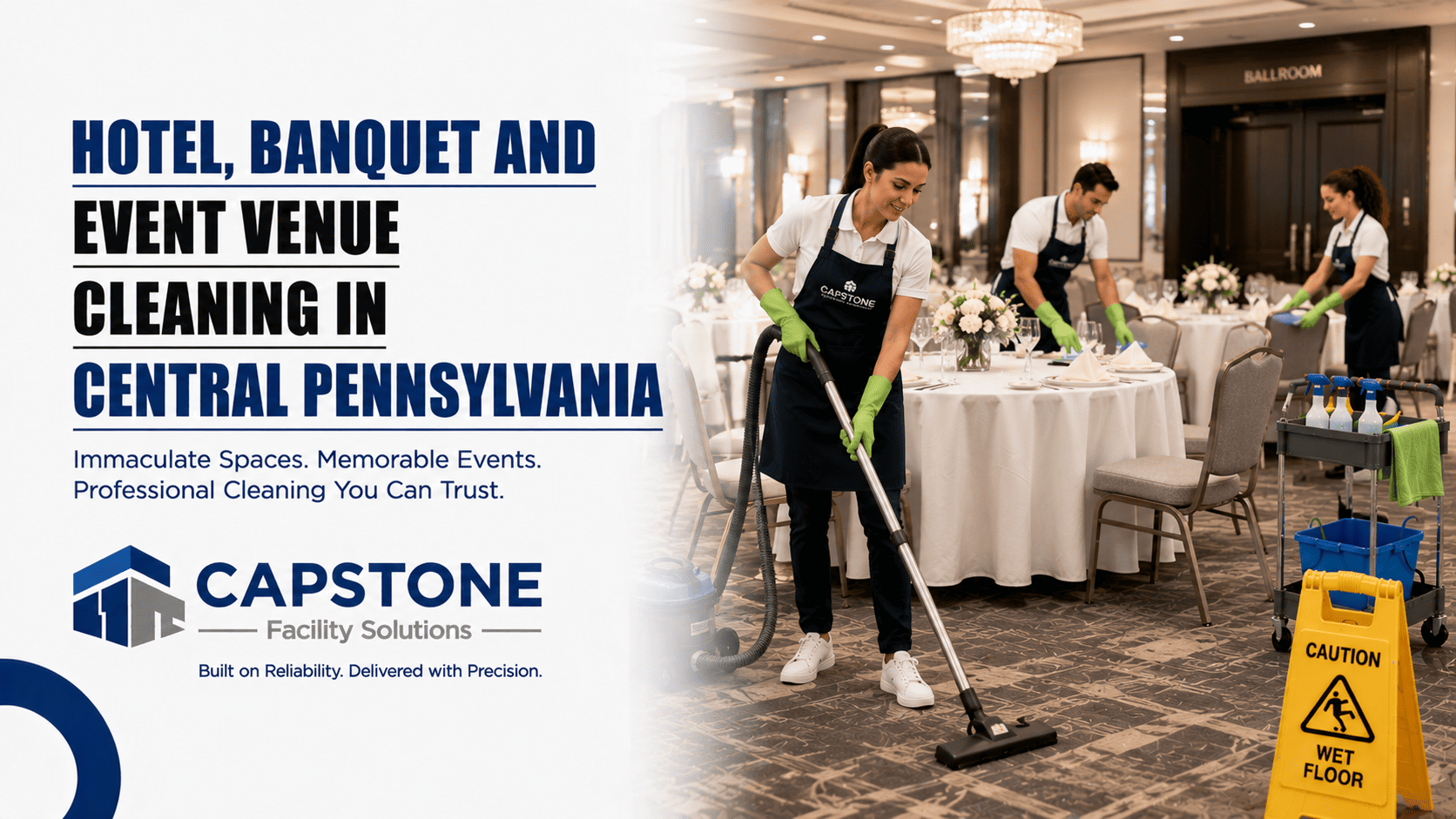
This is the core of venue work and the service most venues actually need. A full post-event clean typically covers:
The scope boundary worth defining up front is what happens to things that aren’t trash. Rental returns, client property, gifts, and forgotten items need a stated process — set aside in a defined place, not discarded. This is the single most common source of friction after an event, and it’s easily solved by writing it into the scope rather than leaving it to judgment at 1am.
The scheduling is what makes this work different, and it’s usually the reason a venue calls. Common patterns:
A venue’s real requirement is usually capacity at unsociable hours rather than any particular technique. Being able to put a crew in a room at midnight on a Saturday is the service.
Event spaces take concentrated abuse in short bursts, and the flooring is what suffers.
Carpet in a banquet space wears faster than almost any commercial floor, because every spill is food or drink and every event brings hundreds of people. Regular extraction and prompt spot treatment are what determine whether the carpet lasts five years or fifteen — the same economics covered in our guide to commercial floor care.
Event restrooms take a full building’s daily usage in a four-hour window, which is a genuinely different problem from ordinary commercial restroom cleaning.
During-event restroom attention is essentially day porter work applied to an event, and larger venues frequently contract it separately from the post-event clean. It’s the detail guests remember most reliably.
Where hotels outsource cleaning, it’s usually public areas rather than guest rooms.
The fitness room deserves specific mention: hotel fitness rooms are cleaned inconsistently almost everywhere, and they appear in guest reviews disproportionately. The scope for them is covered in our post on gym and fitness facility cleaning.
Venue and hotel cleaning happens in front of people, which changes the job. Practical requirements:
A crew that understands event flow is materially more useful than one that only cleans well. Knowing to wait while a photographer finishes, or that the rental company collects chairs at 7am and the room needs to be clear before then, is what makes the difference on a tight turn.
Event work is seasonal, and both sides have to plan for it.
Most venues need surge capacity rather than a constant crew. Booking peak-season dates well ahead is worth doing on both sides — a Saturday in June is spoken for months in advance.
Winter is also when the deep work should happen, for the same reason it applies to floor refinishing: doing it in the middle of event season means it’s immediately undone.
Event cleaning has more ambiguity than most commercial work, so a few things need writing down:
Our guide to what a cleaning contract should include covers the general framework; the items above are the venue-specific additions.
For most commercial buildings, a cleaning failure is an annoyance. For a venue, it’s a booking.
A room that isn’t ready when the next client walks in is a visible, immediate failure in front of paying customers on what is often the most significant day of their year. Venues carry that risk directly, and it’s why reliability outranks price in this category more than almost any other.
That works both ways. A venue that has to chase a crew, or that discovers at 8am that the overnight team didn’t show, will change vendors immediately regardless of rate. A vendor who consistently hits the turn becomes very difficult to displace — event businesses are relationship-driven and don’t re-shop a supplier who works.
It also means the honest conversation about capacity matters. A cleaning company that takes a June Saturday it can’t reliably staff does more damage than one that says no.
Capstone Facility Solutions provides commercial cleaning services throughout Central Pennsylvania, including banquet halls, event venues, conference facilities, and hotels in Harrisburg, Hershey, Lebanon, Palmyra, and surrounding communities.
We work the hours the job requires — overnight, weekends, and same-day turns — and we build the scope around your turnaround rather than our schedule. The process for decor, rentals, and client property is defined in writing before the first event, not decided at 1am. Every team member is background-checked and presentable, because in a venue they’re working in front of your clients.
We’re locally owned, so the person who quotes your venue is the person you reach when a Saturday runs long. We carry general liability and workers’ compensation coverage, with certificates provided on request.
All work is backed by our 100% satisfaction guarantee, and event work can be arranged per event or as a seasonal agreement.
Typically clearing glassware and place settings, removing linens, trash and recycling removal, decor clearing, table and chair wiping, floor clearing and spot treatment, hard floor and dance floor cleaning, restroom cleaning and restocking, bar area cleaning, and lobby and entry cleaning.
It depends on size, guest count, and event type, and on whether the room is being cleared, reset to a layout, or fully deep cleaned. Most post-event turns are scoped against the venue’s required ready-time rather than an hourly estimate — the deadline defines the crew size.
Yes. Overnight and weekend work is the norm in event cleaning, since the turn usually has to happen between a late finish and a morning booking.
That should be defined in the scope before the first event. The standard approach is that anything not clearly trash is set aside in a designated place rather than discarded, with rentals staged for collection. Ambiguity here is the most common source of post-event disputes.
That depends on the scope. In many venues the kitchen and dish areas belong to the catering staff, and the cleaning scope covers event space, restrooms, and public areas. Commercial kitchen deep cleaning is a separate service with its own requirements.
Usually per event, based on space size, guest count, event type, and required turnaround. Venues with regular bookings often move to a seasonal agreement, which is generally better value and secures capacity during peak months.
Hotel work is typically focused on public and guest-facing areas — lobbies, corridors, public restrooms, breakfast areas, fitness rooms, and meeting spaces — rather than guest rooms, which most properties handle through their own housekeeping.
As early as possible. Saturdays through wedding season are committed well in advance on both sides, and a venue that books its cleaning capacity early avoids scrambling in June.
Turnaround requirements vary enormously between venues — and the scope should be built around your booking calendar rather than a generic checklist.
Call Capstone Facility Solutions at 717-298-7157 to schedule a free walkthrough and get a post-event and public area cleaning plan for your venue.
Tell us about your facility and we will send a custom, no-obligation price — usually within a day.