In multifamily, cleaning has a deadline attached to revenue. A resident moves out on the 31st, a new lease starts on the 3rd, and the unit has to be genuinely rent-ready in between — not “mostly clean,” but clean enough that a new resident walks in and doesn’t find someone else’s grime in the oven or hair in the shower drain.
Multiply that by a community with two hundred units and normal turnover, add a leasing season where half the year’s move-outs land in a ten-week window, and cleaning stops being a background service. It becomes part of how quickly units get leased and how the first day of a tenancy goes.
For apartment communities across Harrisburg, Mechanicsburg, Hershey, Lebanon, and the surrounding corridors, a cleaning partner needs two things: the ability to turn units to a consistent standard on a short window, and the capacity to do several at once when the calendar demands it.
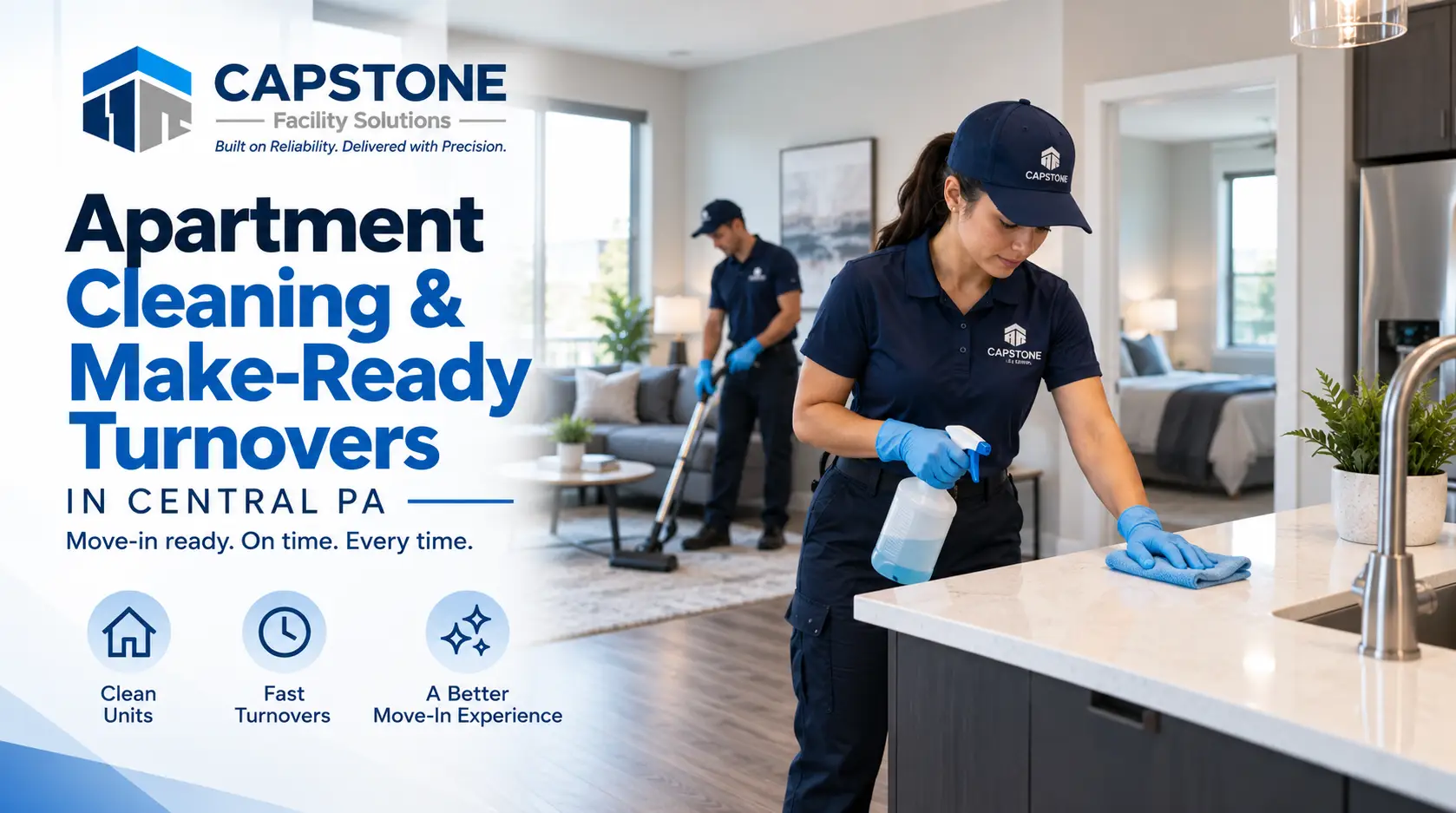
Make-ready — also called rent-ready or turnover cleaning — is a full detail clean of a vacated unit, taking it from “someone moved out” to “someone can move in.”
A complete make-ready typically includes:
Kitchen
Bathrooms
Throughout the unit
The parts residents notice most on move-in are consistent: the oven, the refrigerator, the shower grout, and cabinet interiors. Those four are what separate a make-ready that generates a day-one complaint from one that doesn’t.
It’s worth being clear about the difference, because pricing follows it.
A routine clean maintains an occupied space. A make-ready is a detail clean of an empty one — inside appliances, inside cabinets, inside closets, into corners that furniture has covered for two years. It takes considerably longer per square foot, and it’s priced per unit rather than by an hourly visit.
Condition drives the range more than unit size does. A well-kept one-bedroom left in good condition is a straightforward job. The same unit after a difficult tenancy — heavy grease, pet damage, smoke residue — can take several times as long. Any honest per-unit quote accounts for condition tiers rather than quoting one flat number for everything.
Worth stating plainly, because vendors sometimes blur it and community managers get burned.
Make-ready cleaning is cleaning. It does not include:
A cleaning crew will often find these issues — a failed seal, a soft spot under a sink, a stain that won’t lift — and the useful thing is prompt reporting so maintenance can act before the leasing deadline. A vendor who reports clearly is worth more than one who quietly cleans around a problem.
Carpet cleaning sits on the line: extraction is frequently included or added as a separate line item. Worth confirming in the scope either way. Our commercial floor care page covers extraction in more detail.
Beyond unit turns, the community itself needs an ongoing program — and it’s what prospective residents see on a tour.
Trash rooms deserve particular attention. They’re the least pleasant part of the scope and the first thing residents mention when it slips.
This is the operational core of multifamily cleaning, and where the work differs most from every other vertical.
The practical requirement is flexibility. A community needs a vendor who can do three units this week and eleven the week after, scheduled around maintenance rather than ahead of it. Coordination with the maintenance schedule matters as much as cleaning quality — a unit cleaned before paint has to be cleaned again.
Make-ready quality is verified by a walk, and building the process around that is what keeps a vendor and a community aligned.
Most friction between communities and cleaning vendors comes from an unwritten standard. “Rent-ready” means different things to different people, and a checklist agreed at the start ends that argument permanently. The same principle applies as in any cleaning contract — see our guide to what a cleaning contract should include.
Unlike an office building, people live here — and they’re home at all hours.
Residents notice cleaning crews far more in multifamily than in commercial buildings, and a courteous crew becomes part of how the community feels to live in.
Multifamily management is consolidated, and the advantages of one vendor across several communities are real.
As with commercial portfolios, the sensible approach is starting with one community, proving the standard through a peak season, and expanding. Any vendor worth using will accept that.
The obvious cost of a slow or poor make-ready is vacancy. A unit that isn’t ready doesn’t lease, and every extra day is rent that doesn’t come in. Multiply modest delays across a portfolio and it’s a real number.
The less obvious cost is the first day of a tenancy. A resident who finds the oven dirty or hair in the drain on move-in day starts the lease already unhappy — and that shows up in reviews, in renewal decisions, and in the volume of service requests the office fields in week one. Online reviews of apartment communities mention move-in condition constantly, and prospective residents read them.
There’s a leasing dimension too. Prospects tour vacant units and common areas, and they compare communities the same week. A clean unit and a tidy clubhouse do quiet work in that comparison.
There’s also a practical side. Branches are high-touch environments — pens, counters, door handles, ATM keypads — used by a steady stream of customers every day. Consistent cleaning of those surfaces is basic hygiene for staff and customers alike.
And for institutions subject to audits, inspections, and regular executive visits, a branch that’s clean every morning is one less thing to worry about.
Capstone Facility Solutions provides commercial cleaning services throughout Central Pennsylvania, including apartment communities in Harrisburg, Mechanicsburg, Hershey, Lebanon, Palmyra, and surrounding areas.
We work from your make-ready checklist, not a generic one, so “rent-ready” means the same thing to both of us. We schedule around your maintenance sequence rather than ahead of it, correct punch items on a same-day or next-day basis because the lease date doesn’t move, and keep crews consistent so they learn your standard.
Every team member is background-checked — a baseline requirement in a residential community — and we carry general liability and workers’ compensation coverage with certificates provided on request.
We can also take on the common area and amenity program alongside turns, so the leasing office, corridors, fitness room, and trash areas are handled by the same vendor on the same relationship. See our full janitorial services programs.
All work is backed by our 100% satisfaction guarantee, with no long-term contract required.
Make-ready — also called rent-ready or turnover cleaning — is a full detail clean of a vacated apartment, including inside appliances, cabinets, and closets, bathrooms scrubbed to grout, floors, baseboards, blinds, fixtures, and vents, taking the unit from move-out condition to ready for a new resident.
It depends on unit size and condition more than anything else. A well-kept one-bedroom is a straightforward job; the same unit after a difficult tenancy with heavy grease or pet damage can take several times as long. Condition tiers should be built into any per-unit quote.
Standard cleaning maintains an occupied space. Make-ready is a detail clean of an empty one — inside appliances, inside cabinets, into corners furniture has covered for years — and it’s priced per unit rather than by an hourly visit.
No. Make-ready cleaning is cleaning. Painting, drywall repair, carpet replacement, appliance repair, pest treatment, and remediation work belong to other trades. Carpet extraction sits on the line and is often included or quoted as a separate item — worth confirming in the scope.
That’s the core requirement in multifamily. Leases end on the last day of the month and turnover concentrates in summer, so communities need a vendor who can scale from a few units one week to a dozen the next.
Common areas, corridors, stairwells, mail rooms, fitness rooms, trash rooms, and the leasing office are typically covered by an ongoing cleaning program, separate from turn work. Many communities use the same vendor for both.
Yes. All Capstone Facility Solutions team members are background-checked, which is a baseline requirement in residential communities where crews work in and around residents’ homes.
Per unit, based on size and condition, usually with condition tiers rather than a single flat rate. Communities with regular volume generally move to an agreed per-unit schedule across the portfolio.
Every community has its own make-ready standard and its own leasing rhythm. The fastest way to a workable scope and per-unit pricing is a walkthrough of a vacant unit and your common areas.
Call Capstone Facility Solutions at 717-298-7157 to schedule a free assessment for one community or a portfolio.
Tell us about your facility and we will send a custom, no-obligation price — usually within a day.