Most congregations clean their own building, and for a long time that works. A few reliable volunteers, a rotation, a Saturday morning. It’s how a great many churches in Central Pennsylvania have kept their buildings for decades.
It usually stops working for one of a few reasons. The couple who quietly did it for fifteen years steps back. The rotation stops filling. The congregation grows, or takes on a preschool or a weekly community program, and the building is suddenly in use five days a week instead of one. Nobody makes a decision to stop cleaning — the standard just slips gradually until someone notices the nursery carpet.
A church building is also more complex than its budget usually reflects. A modest congregation may be maintaining a sanctuary, a fellowship hall, a commercial-grade kitchen, a nursery, classrooms, offices, and several restrooms — ten thousand square feet or more, used intensively on one day and lightly the rest of the week.
This covers what a cleaning program for a place of worship typically includes, how the scheduling usually works, and how congregations tend to think about the volunteer question.
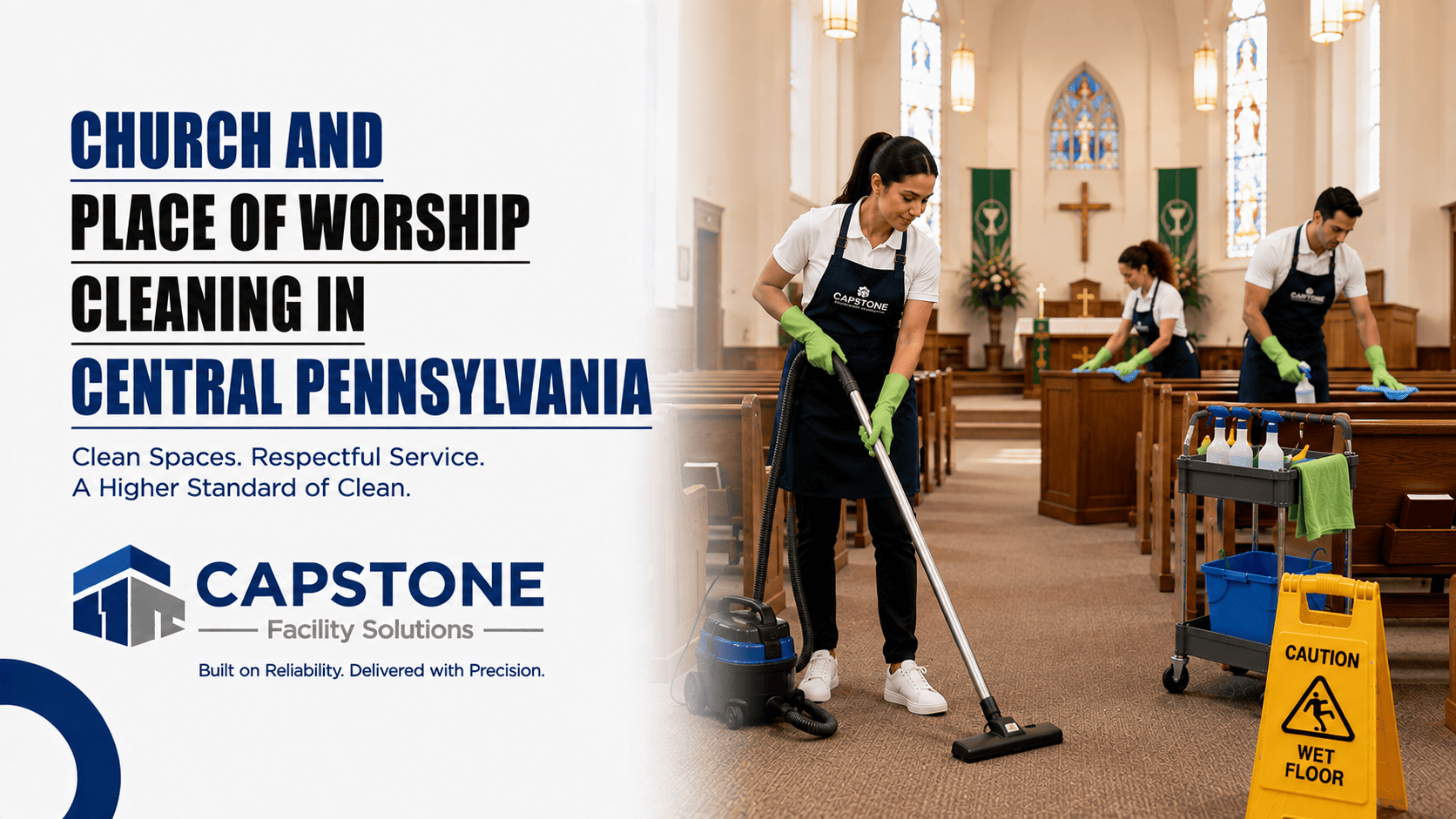
The main worship space is the most visible room in the building and, in practice, one of the easier ones to maintain — it’s used heavily for a few hours a week and lightly otherwise. A regular routine covers:
A note on the areas that matter to a congregation. The chancel, altar area, communion table, instruments, and any items used in worship should be cleaned only as the congregation directs — and in many churches these are handled by members rather than by a cleaning contractor at all. A good vendor asks what’s in scope and what isn’t, rather than assuming, and treats the answer as a firm boundary. This is worth settling at the walkthrough, not discovering later.
The same applies to anything a congregation considers sacred or fragile: sound equipment, instruments, memorial items, and stained glass. Ask first.
The fellowship hall usually works harder than the sanctuary — meals, coffee hours, meetings, community groups, funerals, and rentals.
Because this room is used for so many different purposes by so many different groups, it’s the space where “someone will get it” most often means nobody does.
Many churches have kitchens that are commercial-grade in equipment and residential in how they get cleaned — because they’re used by rotating volunteer groups with no consistent standard.
Worth flagging: a church kitchen used only for congregational meals is different from one supporting a licensed preschool, a regular community meal program, or paid rentals. If the kitchen falls under any health department requirement, the standard and frequency change accordingly, and the congregation will know which applies. Food-contact surfaces need sanitizer appropriate for food contact rather than general disinfectant — the same distinction covered in our post on restaurant and food service cleaning.
This is where congregations most often decide they need professional help, because parents notice it and because volunteer cleaning is least consistent here.
Churches running a licensed preschool or daycare in the same space have additional requirements, and the cleaning program should be built to support whatever protocol that program operates under. The scope for that is covered in our post on daycare and childcare center cleaning.
Education wings and meeting rooms see varied use across the week:
Usage varies enormously room to room, which makes a rotating schedule more sensible than cleaning every classroom every week.
Church restrooms have an unusual pattern: near-zero use for most of the week, then heavy concentrated use in a two-hour window.
The concentration is what matters for scheduling. Restrooms cleaned mid-week and then used by two hundred people on Sunday morning will need attention before the following service — which is why most congregations settle on cleaning after the main service day rather than before it.
Church offices work like any small professional office:
One practical point: church offices hold pastoral records, counseling notes, and member information. Cleaning staff should be briefed on the same confidentiality expectations that apply in medical or legal offices — leaving paperwork undisturbed and reporting rather than handling anything exposed.
Church scheduling has a distinctive rhythm, and the right pattern depends on how much the building is used beyond the main service.
Weddings, funerals, and rentals also fall outside the regular rhythm and often need per-event cleaning — the same kind of turnaround work covered in our post on event venue cleaning.
Most congregations considering a cleaning company are weighing it against volunteer labour that’s currently free, which makes the decision feel harder than it is. A few things worth naming honestly.
Volunteer cleaning works well in specific conditions — a smaller building, light mid-week use, and a genuinely willing group of people. Where those hold, it can work for years, and there’s no reason to change it.
It usually fails for structural reasons rather than a lack of commitment. The work concentrates on a few people, it’s invisible when done and obvious when missed, and the volunteers who do it are frequently the same people already carrying several other roles. When it breaks down it’s rarely because anyone stopped caring.
The parts that most often need outsourcing first are the ones volunteers reasonably shouldn’t be doing: restrooms, nursery disinfection, kitchen deep cleaning, floor refinishing, and anything requiring equipment. Many congregations land on a hybrid — volunteers handle straightforward upkeep, and a contractor handles restrooms, the nursery, and periodic project work.
The cost is usually smaller than expected, because a church building is used less than an office of the same size. A weekly clean of a 10,000 square foot church is a very different job from a 10,000 square foot office cleaned five nights a week.
If your congregation is having this conversation, the practical first step is writing down what actually needs doing and how often — before pricing anything. Most churches find the list is shorter than they feared. The broader version of this decision is covered in our guide to in-house versus outsourced cleaning.
Capstone Facility Solutions provides commercial cleaning services throughout Central Pennsylvania, including churches and places of worship in Harrisburg, Hershey, Lebanon, Palmyra, and surrounding communities.
We build the scope around your building and your week rather than a generic checklist — including what stays with your own members and what doesn’t, settled at the walkthrough. We ask before touching anything in the worship space, and we treat that boundary as fixed. Every team member is background-checked, which matters in a building that hosts children’s programs and often has keys in circulation among volunteers.
We carry general liability and workers’ compensation coverage and provide certificates of insurance on request — something most church boards need for their records.
We work without long-term contract requirements, and every program is backed by our 100% satisfaction guarantee. If a partial scope makes more sense for your congregation than a full one — restrooms and nursery only, for instance, with volunteers continuing elsewhere — that’s a reasonable arrangement and one we’re happy to quote.
Most congregations clean weekly, after the main service day, with monthly deeper work and periodic projects like carpet extraction and floor refinishing. Churches hosting preschools, schools, or regular mid-week programs generally need multiple days a week.
Typically the sanctuary or worship space, fellowship hall, kitchen, nursery and children’s areas, classrooms, restrooms, offices, and entries — plus periodic high dusting, floor care, and window cleaning. What’s included in the worship space specifically is set by the congregation.
Less than an office building of comparable size in most cases, because church buildings are used fewer days per week. Pricing depends on square footage, number of restrooms, frequency, and scope. Partial scopes — restrooms and nursery only, for example — are common and cost proportionally less.
Volunteer cleaning works well with a smaller building, light mid-week use, and a willing group. It tends to break down when the building’s use grows or when the work concentrates on a few people. Many congregations use a hybrid, with volunteers handling general upkeep and a contractor covering restrooms, the nursery, and periodic project work.
That is the congregation’s decision, settled before work begins. In many churches the chancel, altar area, communion items, and instruments are cared for by members rather than a contractor, and a cleaning company should ask what is and isn’t in scope rather than assume.
Yes. All Capstone Facility Solutions team members are background-checked before working in any facility, which matters particularly in buildings hosting children’s programs. The company carries general liability and workers’ compensation coverage with certificates available on request.
Yes. Per-event cleaning outside the regular schedule is common in church buildings, and can be arranged either as part of the program or per event.
Every congregation’s building and week is different, and so is what makes sense to hand off. A walkthrough is the quickest way to get a realistic picture of both scope and cost — including a partial scope if that’s the better fit.
Call Capstone Facility Solutions at 717-298-7157 to schedule a free assessment for your congregation..
Tell us about your facility and we will send a custom, no-obligation price — usually within a day.