Childcare is the one commercial setting where the occupants put their hands on every surface and then put their hands in their mouths. Toys get shared, floors get sat on, and a single illness moves through a classroom in days.
That makes cleaning a daycare a genuinely different job from cleaning an office. The products have to be appropriate for spaces where small children spend all day. The scope includes things no other facility has — toy sanitizing, nap mats, diaper changing areas, cubbies. And the whole program has to support the sanitation standards a licensed center is already accountable for.
For childcare centers, preschools, and early learning programs across Harrisburg, Hershey, Lebanon, and Palmyra, a professional cleaning program handles the thorough end-of-day work so teaching staff can focus on the constant in-the-moment cleaning that childcare actually requires — rather than staying late to mop.
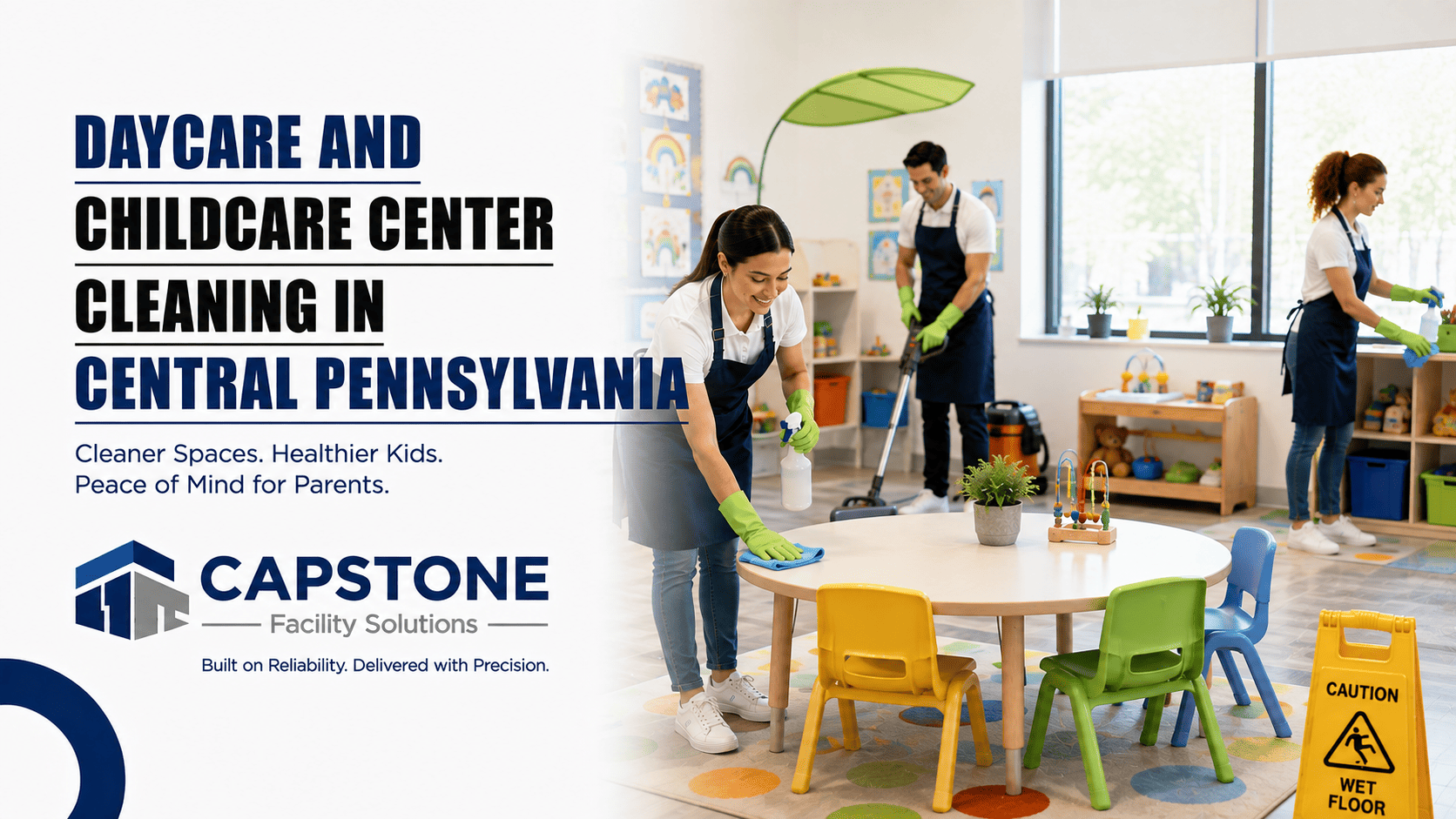
Classrooms are the core of the scope, and they differ by age group more than most facilities differ building to building.
A nightly classroom routine covers:
Infant rooms need additional attention: cribs and crib rails, bouncy seats, floor mats, and the floor itself, since infants spend most of the day on it.
Toddler and preschool rooms concentrate wear on tables, chairs, and low surfaces where food, art materials, and hands all land.
This is the item most centers struggle with, because it’s labour-intensive and never quite finished.
A cleaning program can support it through:
Soft toys and fabric items generally need laundering rather than surface cleaning, which usually stays with center staff or a laundry service. And sanitizing only works on a genuinely clean surface — visible soil has to come off first, because disinfectant applied over grime doesn’t do its job.
Most centers run toy sanitizing as a shared responsibility: staff handle mouthed items immediately during the day, and the cleaning program handles systematic batch sanitizing after hours. Which items fall where should be written into the scope explicitly rather than assumed.
These areas carry the highest contamination risk in the building and the most direct licensing attention.
Cleaning covers:
Staff perform changing-surface disinfection continuously through the day as part of the center’s own protocol. The cleaning program handles the thorough end-of-day work — floors, walls, fixtures, and the surrounding area that daytime routines don’t reach.
Sleep surfaces get direct, prolonged face contact and are frequently under-cleaned:
Bedding is generally laundered by the center or sent home with families on a set cycle. Mat and cot *surfaces* are the cleaning program’s responsibility, and they need disinfection rather than a wipe — a child’s face is on that surface for two hours a day.
Centers serving meals or snacks have food service areas subject to their own standards:
Adult buildings concentrate touch points at 36–48 inches. A childcare center concentrates them at 18–30 inches, which is a genuinely different cleaning map:
A crew accustomed to office cleaning will clean at adult height by habit. Cleaning a childcare center properly means deliberately working the lower band, where the actual contact happens.
The front of the center is what parents see twice a day — and parents are the ones deciding whether to enroll:
A tour is often decided in the first thirty seconds. The entry does a disproportionate amount of that work.
This is where a childcare cleaning program most obviously differs from a commercial one, and where the wrong contractor causes real problems.
Appropriate practice includes:
Licensed centers in Pennsylvania operate under state sanitation requirements, and directors know those requirements well. A cleaning contractor’s role is to support compliance and work within the center’s established protocol — not to claim authority over what the regulations require.
Childcare centers typically run 6am to 6pm with no downtime during the day, which puts cleaning in a narrow evening window:
Centers with early drop-off may need cleaning complete by 5:30am rather than simply “overnight,” which is worth confirming in the scope rather than discovering in week two.
Illness transmission is the reason. Young children have developing immune systems, limited hygiene habits, and constant close contact — and when illness moves through a classroom, the cost lands on everyone. Children are out, parents miss work, and staff coverage gets difficult exactly when several staff are also out.
Consistent cleaning and disinfection of shared surfaces, toys, and high-touch points is one of the practical controls a center has. It doesn’t eliminate illness, and no reputable contractor should claim it does — but a center with a thorough program and one without are meaningfully different environments.
There’s an enrollment dimension too. Parents touring a center notice cleanliness before they notice curriculum, and they ask about it directly. Being able to describe a professional cleaning program with a written scope is a concrete answer to a question directors get constantly.
And for licensed facilities, sanitation is part of what’s inspected. A center that maintains standards consistently isn’t scrambling before a visit.
We build the scope around your center’s classrooms, age groups, and protocol rather than a generic checklist, and we work within the products and methods your center specifies. Cleaning is scheduled after hours so children are never present during application. All chemicals are stored secured and out of reach, and every team member is background-checked before working in your facility.
We carry general liability and workers’ compensation coverage and provide certificates of insurance on request — something most centers need on file for their own records.
All work is backed by our 100% satisfaction guarantee, with no long-term contract required.
Most centers need full cleaning nightly, covering classrooms, bathrooms, kitchen, and common areas, with weekly deeper work on toy sanitizing and detailed bathroom cleaning, and monthly attention to vents, fixtures, and wall washing. Same-day soil in a childcare setting shouldn’t sit overnight.
Hard plastic toys and equipment are washed to remove visible soil, then sanitized with an appropriate product at the required contact time. Soft toys and fabric items generally need laundering rather than surface cleaning. Most centers split this between staff handling mouthed items during the day and systematic batch sanitizing after hours.
EPA-registered disinfectants used according to label instructions, selected to be appropriate for childcare settings — avoiding harsh chemistry and strong fragrance. Cleaning is done after hours so surfaces dry and ventilate before children return, and food-contact or mouthed surfaces are rinsed where the label requires it.
No. Childcare cleaning is scheduled after the center closes so no children are present during application, surfaces have time to dry, and rooms ventilate before the next morning.
Yes. This includes changing surfaces, surrounding walls and cabinets, hand-washing sinks, diaper disposal areas, child-height fixtures, floors, and restocking. Staff handle changing-surface disinfection continuously during the day; the cleaning program handles thorough end-of-day work.
Yes. All Capstone Facility Solutions team members are background-checked before working in any facility, and the company carries general liability and workers’ compensation coverage with certificates available on request.
Yes. Licensed centers have established protocols and product requirements, and the cleaning scope is built to work within them rather than replace them.
Every childcare center has a different mix of age groups, classrooms, and protocol requirements — which is what determines the right scope and schedule.
Call Capstone Facility Solutions at 717-298-7157 to schedule a free on-site assessment and receive a cleaning plan built around your center’s classrooms and hours.
Tell us about your facility and we will send a custom, no-obligation price — usually within a day.