
The comparison most businesses run is simple and wrong. They take a cleaning company’s monthly quote, divide by the hours the crew would be on site, compare it to an hourly wage, and conclude that hiring someone directly is cheaper.
It usually looks cheaper because the comparison is missing about half the cost. An employee’s wage is one line in a much longer list — payroll taxes, workers’ compensation, benefits, paid time off, equipment, chemicals, consumables, supervision, and the cost of covering the job when that person is sick or quits.
None of that makes outsourcing automatically correct. There are real situations where hiring in-house is the better decision, and this covers those too. But the two options can only be compared honestly once both are costed the same way.
A note on numbers: this guide gives the structure of the comparison rather than specific dollar figures, since wage rates and benefit costs vary by market and change year to year. Run the categories against your own local numbers.
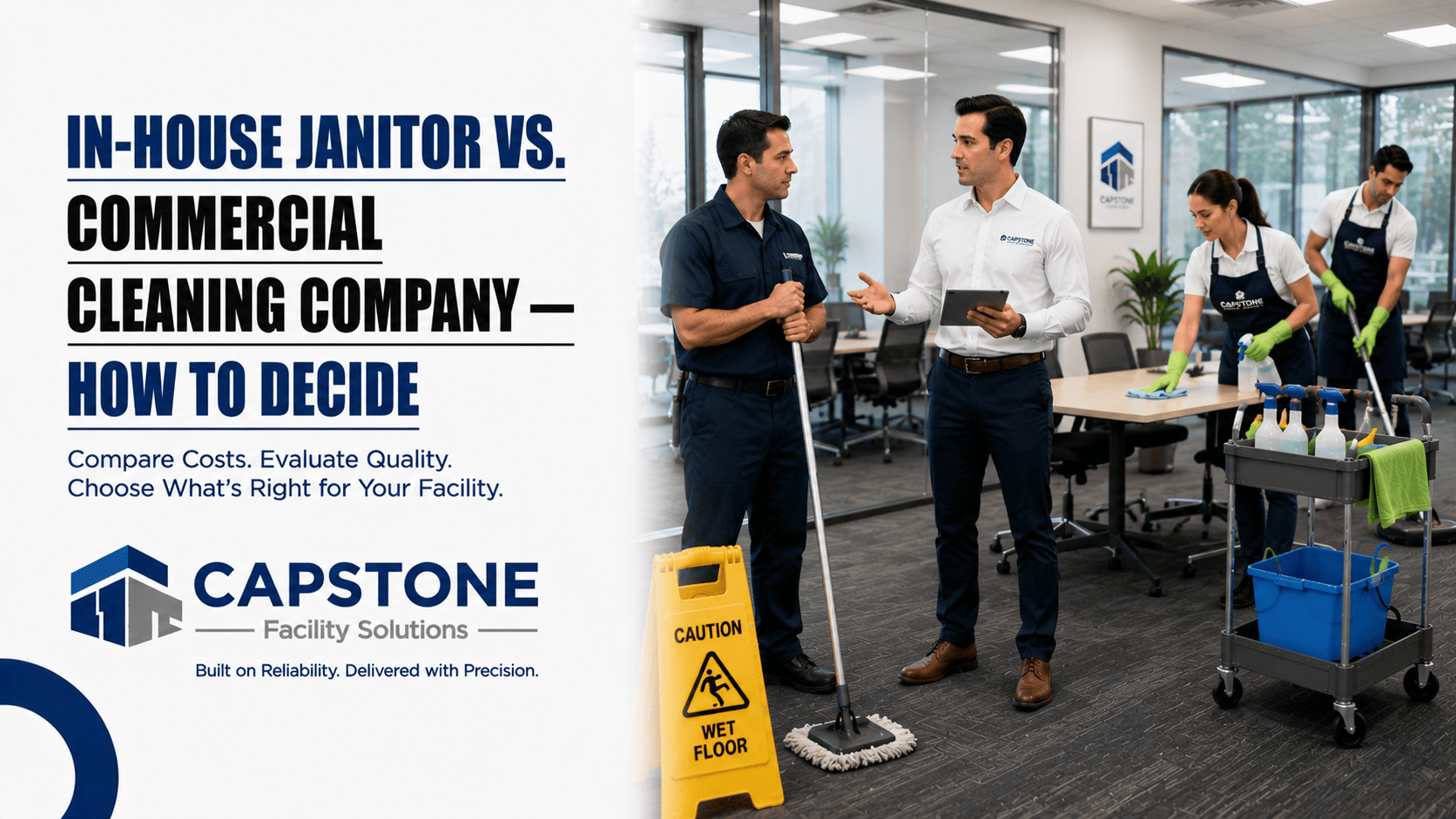
The wage is the starting point, not the total. A fully-loaded cost includes:
Direct compensation
– Base wage or salary
– Overtime, where the schedule requires it
– Any shift differential for evening or overnight work
Employer taxes and mandatory costs
– Employer share of FICA (Social Security and Medicare)
– Federal and state unemployment insurance
Workers’ compensation— often higher for cleaning work than office roles, since it involves chemicals, ladders, and repetitive physical labour
Benefits, if offered
– Health insurance contribution
– Retirement contribution
– Paid time off, holidays, and sick leave — note that PTO is a real cost twice: you pay for the time, and you pay again for coverage during it
Equipment and supplies — the capital nobody budgets
– Vacuums, floor machines, carts, mop systems, buckets
– Cleaning chemicals and dilution equipment
– Consumables: liners, soap, paper products
– Equipment repair and replacement
– Storage space, which is a real cost in leased premises
Management overhead
– Recruiting and hiring time
– Training and onboarding
– Ongoing supervision — someone has to define the work, check it, and manage performance
– Payroll administration
– Performance management and, if necessary, termination
Turnover
– Janitorial roles have high turnover industry-wide
– Each departure means recruiting cost, training cost, and a coverage gap
– The building’s standard drops during every transition
Add those categories up honestly and the hourly wage typically represents somewhere well short of the true cost. That’s the number to compare against a cleaning company’s quote — not the wage.
The other side of the comparison is usually simpler than people expect, because the quote is close to the total.
A commercial cleaning contract typically includes:
– All labour, including the employer’s taxes, insurance, and benefits
– All equipment and its maintenance and replacement
– All cleaning chemicals
– Supervision and quality management
– Coverage when someone is sick or leaves — the vendor’s problem, not yours
– Liability and workers’ compensation insurance
– Training
The main variable to confirm is consumables — soap, paper products, and liners are sometimes included and sometimes billed separately or supplied by the client. That’s the most common gap between a quote and the real monthly figure, and it’s worth clarifying before comparing anything.
This is the operational difference businesses feel first, usually within a few months.
With an in-house cleaner, when that person is sick, on vacation, or has left, the building doesn’t get cleaned. There is no bench. Someone internal covers it, you go without, or you scramble for a temporary fix. Over a year, that’s several weeks of degraded service built into the arrangement — plus the gaps during any hiring transition.
With a cleaning company, coverage is the vendor’s obligation. Absences, turnover, and vacations are absorbed on their side, and the building gets cleaned regardless.
For a small office where a few missed days is a minor annoyance, this may not decide anything. For a medical practice, a childcare center, a restaurant, or a customer-facing building, coverage is not optional — and a single-point-of-failure arrangement is a genuine operational risk.
An in-house cleaner reports to someone. That someone has to define the scope, check the work, handle performance issues, and stay current on what should be done and how — which in practice means a manager who has other responsibilities and no particular expertise in cleaning.
This is where in-house arrangements most commonly drift. Nobody’s job is to notice that the high dusting hasn’t been done since spring, so it isn’t noticed. Scope quietly shrinks toward whatever is most visible.
With a vendor, supervision and quality management are part of the service, and the scope is written down — which gives you something concrete to hold them to. The trade is that you’re managing a relationship rather than a person, which suits some managers and not others.
Needs change, and the two models flex very differently.
In-house is rigid. More cleaning means more hours or another hire. Less cleaning means an employee with idle time, or a difficult conversation. Specialised work — floor refinishing, carpet extraction, window cleaning, post-construction cleanup — generally requires equipment and training a single employee won’t have, so it gets outsourced anyway or simply doesn’t happen.
For a business that’s growing, moving, or opening additional sites, that flexibility often matters more than the cost comparison does.
This is a real list, not a formality. In-house is the better decision when:
The building needs genuine full-time attention. If there’s honestly forty hours a week of work — a large facility, a school, a manufacturing site — the economics narrow considerably, and the flexibility advantage of outsourcing matters less.
The role is broader than cleaning. Many businesses want a facilities person who cleans and handles minor maintenance, setups, deliveries, and general building tasks. That’s a legitimate hybrid role, and it isn’t what a cleaning contract provides.
Security or confidentiality requirements are unusual. Some environments — certain government, defence, financial, or research facilities — have clearance or access requirements that make a dedicated, directly-employed and individually-vetted person the more practical arrangement.
The facility runs continuously with constant need. Some 24/7 operations need someone always present rather than someone visiting on a schedule.
You already have the right person. A long-tenured, reliable employee who knows the building is a real asset. Replacing something that works with a vendor relationship to save a modest amount is rarely worth the disruption.
If two or three of those describe your situation, hiring in-house is likely the right call, and any cleaning company telling you otherwise is selling rather than advising.
The choice isn’t always binary, and the hybrid is common for a reason.
Many businesses employ someone in-house for daily upkeep — daytime tidying, restroom checks, spill response, setups — and contract a cleaning company for the thorough scheduled work and periodic projects.
That split works because it puts each model where it’s strongest. The in-house person provides daytime presence and building familiarity; the vendor provides equipment, specialised capability, coverage, and the deep work.
A straightforward process:
1. Define the scope first – Write down what actually needs cleaning, in which areas, at what frequency — before pricing either option. Both comparisons are meaningless against an undefined scope, and most businesses discover at this stage that they’ve never written it down.
2. Cost the in-house option fully- Work through every category in Section 1 using current local wage data and your actual benefit costs. Include equipment as a first-year capital cost and an ongoing replacement cost.
3. Get two or three vendor quotes against the same written scope- Same scope, same frequencies — otherwise you’re comparing different jobs.
4. Compare like for like- Confirm what’s in each quote, particularly consumables. Add anything a vendor excludes back into their number.
5. Weigh the non-cost factors- Coverage, supervision burden, flexibility, and the specific situations in Section 6.
6. Consider the hybrid- Especially if the honest answer is somewhere between twenty and forty hours a week of need.
Most businesses that run this properly find the cost gap is much narrower than the wage comparison suggested, and that the decision then turns on coverage and management burden rather than price.
Businesses usually ask this in cost terms, but the real question is generally about control and reliability.
The instinct behind hiring in-house is that a direct employee will care more, be more accountable, and be genuinely yours. Sometimes that’s right — a good long-term employee who knows the building is difficult to beat.
But it comes with single-point-of-failure risk. When that person is out, the work doesn’t happen. When they leave, you’re recruiting for a role with high industry turnover while the building’s standard slips. And the accountability people expect only materialises if someone internal is actually supervising, which frequently nobody is.
The instinct behind outsourcing is that it’s someone else’s problem to solve. That’s largely true — coverage, equipment, training, and supervision genuinely transfer. What you give up is direct control, and what you gain in exchange is only as good as the contract and the vendor.
Which is why the scope of work matters more than either model. A well-specified arrangement works either way; a vague one fails either way.
Capstone Facility Solutions provides serving offices, medical and dental practices, dealerships, schools, retail, and multi-tenant buildings in Harrisburg, Hershey, Lebanon, Palmyra, and surrounding communities.
If you’re weighing this decision, the most useful thing we can do is give you a written scope and a real quote to compare against your in-house numbers — built from a walkthrough of your actual building, with exclusions stated plainly, so the comparison is like for like.
And if the walkthrough suggests your situation is one of the cases in Section 6 where in-house makes more sense, we’ll say so. We’d rather not win a contract that a business regrets in six months.
We work without long-term contract requirements, and every program is backed by our 100% satisfaction guarantee.
It depends on the fully-loaded comparison. An hourly wage understates the true cost of an employee, which also includes payroll taxes, workers’ compensation, benefits, paid time off, equipment, chemicals, supervision, and turnover. Once those are added, the gap is usually much narrower than it first appears, and often reverses for buildings needing less than full-time attention.
Beyond wages: employer FICA, unemployment insurance, workers’ compensation (typically higher for cleaning work than office roles), any benefits, paid time off, equipment and its replacement, chemicals and consumables, storage, recruiting and training, ongoing supervision, and coverage during absences and turnover.
With an in-house employee, nobody — unless you arrange it. The work either doesn’t happen, gets absorbed internally, or requires a temporary arrangement. With a cleaning company, coverage is the vendor’s obligation and the building gets cleaned regardless.
Employers generally must carry workers’ compensation coverage for employees, and rates for cleaning work are typically higher than for office roles because of the physical and chemical exposure involved. Confirm the specifics with your insurance broker for your state and situation.
When there’s genuine full-time need, when the role includes maintenance and building tasks beyond cleaning, when security or clearance requirements demand a directly-employed individual, when a facility operates continuously, or when you already have a reliable long-tenured person doing the job well.
Yes, and it’s common. Many businesses employ someone for daytime upkeep and contract a cleaning company for thorough scheduled work and periodic projects like floor refinishing and carpet extraction. The daytime role can also be outsourced as day porter coverage.
These generally require equipment, training, and insurance that a single employee won’t have, so they’re typically outsourced regardless of which model you choose for daily cleaning. That’s worth factoring into the in-house cost comparison rather than treating it as free.
The comparison only works if both sides are costed properly — which means a written scope and an actual quote, not a rough per-hour estimate.
Call Capstone Facility Solutions at 717-298-7157 for a free walkthrough and a written scope and quote you can put side by side with your in-house numbers.
Tell us about your facility and we will send a custom, no-obligation price — usually within a day.