An independent repair shop runs two businesses in one building, and they have opposite cleaning problems.
The shop side generates oil, grease, coolant, brake dust, and tire marks faster than anyone sweeping between jobs can keep up with. The customer side — a waiting room, a counter, a restroom — is where people sit for ninety minutes deciding whether this place deserves their business, and whether the estimate they just heard is fair.
Most shop owners handle both themselves, usually at the end of a long day, and both suffer for it. The shop floor gets progressively darker until it reads as permanently dirty, and the waiting room gets whatever time is left.
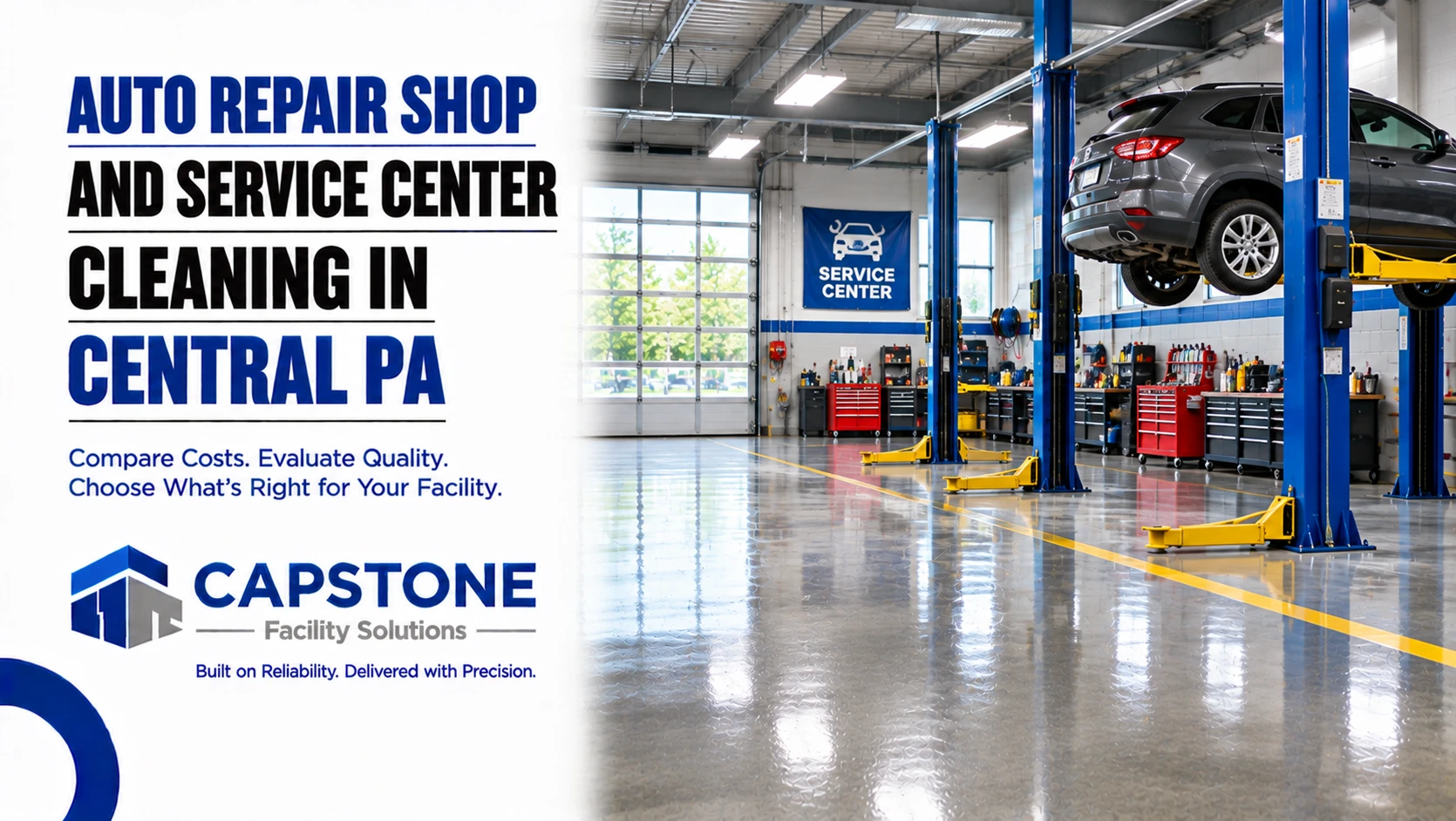
For repair shops, tire centers, quick-lube operations, and collision shops across Harrisburg, Lebanon, Hershey, and Palmyra, a cleaning program handles the parts that actually need equipment and the parts that actually need attention.
This is where an independent shop wins or loses against the dealership service department up the road.
The waiting room is the single highest-leverage item in this scope. A customer who sits for ninety minutes in a clean room with working coffee comes away with a different impression of the same repair bill. It’s also the cheapest part of the building to get right.
Shop-side dirt migrates to the front constantly — on shoes, on hands, through the connecting door. Without a routine, the customer area inherits the shop’s condition within weeks.
Bay cleaning is the volume work, and the scope boundary needs stating first.
What a cleaning contractor handles:
What stays with the shop and its licensed waste hauler:
A cleaning contractor does not collect, transport, or dispose of regulated waste streams. Those are handled under the shop’s own arrangements with its licensed hauler, and any vendor offering to “take care of the oil” has misunderstood how the shop is regulated.
Equipment, vehicles, lifts, and anything requiring a machine to be locked out also stay with shop staff — the same line drawn in our manufacturing plant cleaning guide.
This is the work shop owners most want and least often get done properly.
Oil doesn’t sit on top of a shop floor. On unsealed or worn concrete it soaks in, and a mop or a shop vac moves the surface film around without touching what’s absorbed. The result is a floor that gets progressively darker year over year until the owner assumes it’s permanent.
Proper degreasing involves:
An honest word on results. Surface grease and recent spots come up well. Concrete that has absorbed oil for fifteen or twenty years without a sealer will improve substantially — often dramatically — but it won’t look like new slab, because the staining is in the concrete rather than on it. Any contractor promising a showroom floor on a soaked twenty-year-old slab is overselling.
Sealing changes the economics. Once a floor is cleaned, a concrete sealer keeps future spills on the surface where they can actually be removed. That’s a conversation worth having with a flooring contractor, and it’s what separates a one-time improvement from a floor that stays manageable — related to the finish-protection logic in our commercial floor care guide.
Most shops do best with a deep degreasing project once or twice a year plus routine sweeping and spot attention in between.
Shop restrooms serve customers and technicians, which is a harder combination than either alone.
Customer-facing restrooms in a repair shop take grease transfer constantly. Technicians use them, customers use them, and the result is marked fixtures and dark hand-contact areas that ordinary wiping doesn’t lift. These need degreasing-grade attention rather than standard restroom chemistry, which is the detail most often missed.
Where a shop has separate technician and customer restrooms, the customer one should be held to a waiting-room standard.
Cardboard dust from parts packaging migrates throughout a shop and settles on every horizontal surface, including the customer side. It’s an unglamorous item that affects the whole building.
Service writer desks sit between the shop and the customer and take grease transfer from paperwork, keys, and hands all day.
Winter is the hard season. Salt, slush, and road grime come in on every vehicle, pool in the bays, and track into the customer area on every pair of shoes. Bay floors look worst from December through March and customer entries become a slip concern — covered in more detail in our guide to winter commercial cleaning.
Shops run full days with vehicles on lifts, which shapes when cleaning can happen.
Degreasing needs cleared bays, which means coordinating with the shop’s schedule — often a weekend, a slow Monday, or a planned closure. It’s worth booking ahead rather than hoping for a gap, and it’s the one item that genuinely can’t happen around a vehicle on a lift.
Many shops also benefit from a lighter, more frequent program plus one or two annual projects, rather than trying to do everything nightly.
Auto repair runs on trust, and customers have almost no way to evaluate technical competence. So they evaluate what they can see.
The waiting room is the proxy. A customer who can’t judge whether a brake job was necessary judges the shop by the room they sat in. Fair or not, a clean, organised facility makes an estimate feel more credible, and a grimy one makes the same estimate feel like a markup.
Reviews say it directly. Repair shop reviews mention the waiting area, the restroom, and whether the place looked professional at least as often as they discuss the work itself — and prospective customers read those before calling.
Independents are competing on experience now. Dealership service departments have spent years on comfortable lounges and coffee machines. An independent shop winning on price and honesty still loses customers who found the facility unpleasant.
Shop safety matters too. Oil-slick concrete is a genuine slip hazard for technicians moving quickly between bays, and clear floors reduce trip risk around lifts and tool boxes — the same housekeeping argument as in our OSHA floor safety guide.
Capstone Facility Solutions provides commercial cleaning services throughout Central Pennsylvania, including independent repair shops, tire centers, quick-lube facilities, and collision shops in Harrisburg, Lebanon, Hershey, Palmyra, and surrounding communities. We also serve franchise dealerships across the region — see our dealership cleaning programs.
We build a scope that matches how a shop actually works: a lighter routine program covering customer areas, restrooms, and bay sweeping, plus periodic floor degreasing projects booked when bays can be cleared. We’ll tell you honestly what a twenty-year-old unsealed slab will and won’t look like afterward.
We’re clear about the waste boundary. Used oil, coolant, solvents, batteries, and tires stay with your licensed hauler — we handle general waste and the environment.
Every team member is background-checked, and we carry general liability and workers’ compensation coverage with certificates provided on request. All work is backed by our 100% satisfaction guarantee, with no long-term contract required. See our full janitorial services programs.
By removing loose debris and absorbent first, applying an appropriate degreaser and allowing the full dwell time, agitating mechanically with a floor machine, then extracting or wet-vacuuming the slurry and rinsing. Skipping the dwell time is the most common reason DIY attempts fail.
Surface grease and recent spots come up well. Concrete that has absorbed oil for many years without a sealer will improve substantially but won’t look like new slab, because the staining is in the concrete rather than on it. Sealing after cleaning keeps future spills on the surface where they can be removed.
Most shops use a nightly or several-times-weekly program for customer areas, restrooms, offices, and bay sweeping, with weekly detailed bay work, monthly high dusting, and a deep floor degreasing project once or twice a year.
No. Used oil, oil filters, coolant, solvents, parts-washer fluid, batteries, and scrap tires are regulated waste streams handled by the shop and its licensed waste hauler. A cleaning contractor handles general waste and environmental cleaning only.
When bays can be cleared — often a weekend, a slow day, or a planned closure. It’s the one item that can’t be done around a vehicle on a lift, so it’s worth booking ahead.
Waiting areas, the service counter, and customer restrooms are usually the highest-value part of the scope. Shop-side grease and dirt migrate to the front constantly, so without a routine the customer area inherits the shop’s condition.
Yes — bay door interiors and accessible exteriors, door tracks and thresholds, apron sweeping, lot frontage litter, and dumpster area tidying. Snow removal and paving work are separate trades.
The customer and office side is similar, but collision work generates dust and overspray that need their own attention, and paint booth areas are the shop’s own regulated responsibility rather than a cleaning contractor’s.
Shop size, floor condition, and how much customer traffic you handle all change the right scope — and floor condition in particular needs looking at rather than estimating.
Call Capstone Facility Solutions at 717-298-7157 to schedule a free assessment for your shop.
Tell us about your facility and we will send a custom, no-obligation price — usually within a day.