A bank branch sells one thing above everything else: trust. Customers bring their money, their paperwork, and their questions into a space that’s supposed to feel careful and orderly — and they notice immediately when it doesn’t. A smudged entry door, a dusty teller counter, or a littered ATM vestibule quietly says something about how the institution looks after the details.
Cleaning a branch is also different from cleaning an office. There are cash-handling areas, restricted zones, customer-facing retail space, ATM vestibules open around the clock, and drive-thru lanes. Crews work after hours in a building with security procedures that the institution — not the cleaning company — sets.
For community banks, credit unions, and financial branches across Harrisburg, Hershey, Lebanon, and Palmyra, a good cleaning program is one that keeps every branch looking consistent and works entirely within the institution’s security rules.
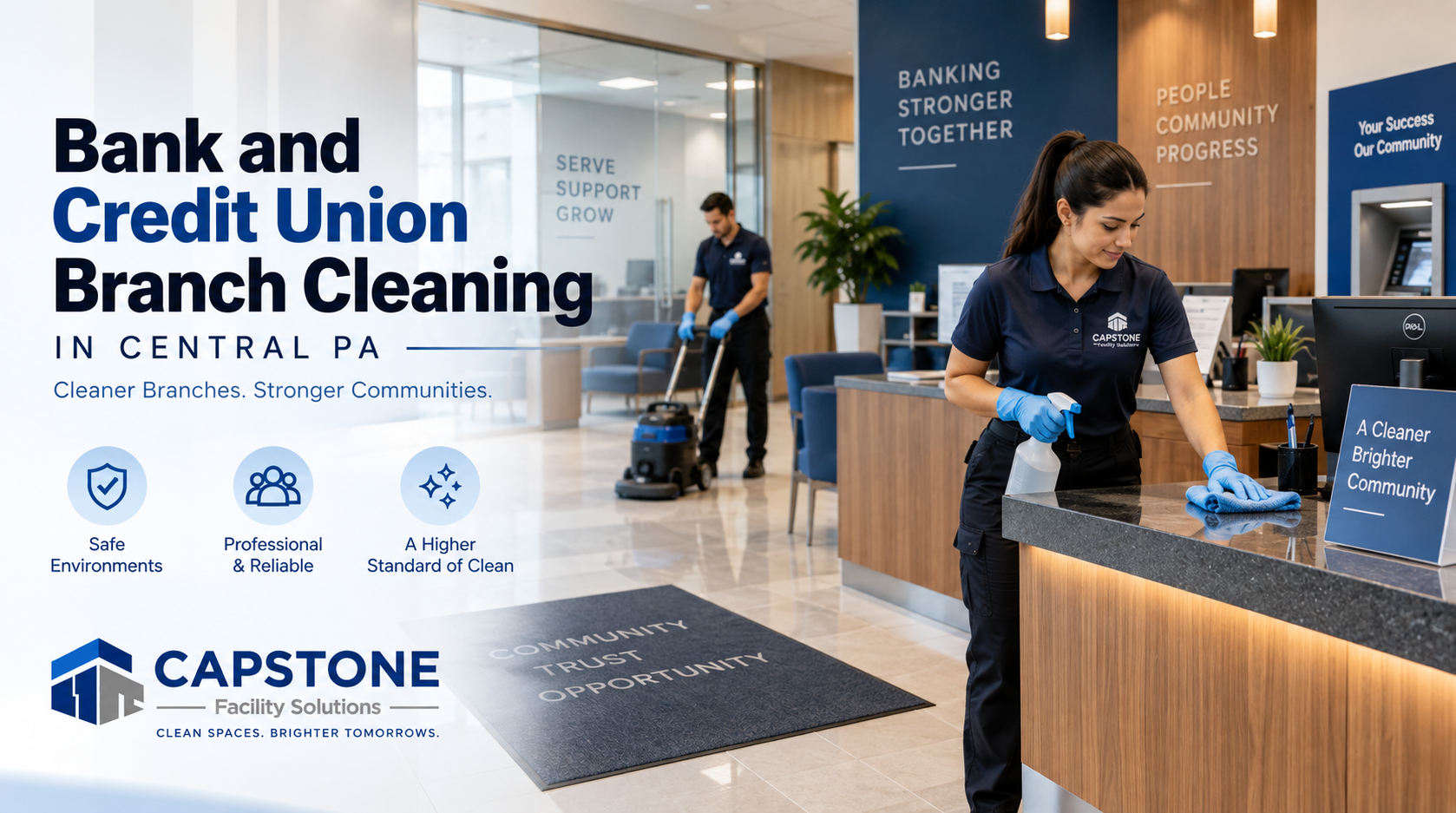
The lobby is the first and most-judged space in the branch.
Entry glass carries more weight here than in most buildings. Branches often have large storefront windows and glass vestibules, and fingerprints and weather marks show immediately. Glass is usually a nightly item at the entrance, with a deeper periodic clean handled through commercial window cleaning.
The teller line is the most high-touch surface in the branch, and it’s also a work area with strict boundaries.
Scope boundary: the teller side — drawers, cash-handling equipment, workstations, documents, and anything secured — is cleaned only as the institution specifies, and many branches keep it off-limits entirely. Crews never move, handle, or clean around cash, paperwork, or secured items. A cleaning company should ask exactly where the line sits at the walkthrough and treat it as fixed.
Branch offices handle sensitive conversations and sensitive documents.
Confidentiality matters more here than anywhere else in the branch. Crews should leave papers, screens, files, and desk contents exactly as found — not stacked, not moved, not read. Shred bins and secure document containers are not emptied by the cleaning crew; they’re handled by the institution’s document destruction vendor. Anything left exposed that looks sensitive gets reported, not touched.
ATM vestibules are often open 24 hours, used by customers at all hours, and cleaned less often than they should be.
Vestibules take tracked-in salt and slush all winter and are frequently the dirtiest customer-facing space in the branch by February. That’s covered in more detail in our guide to winter commercial cleaning.
Note on the ATM itself: the machine is the property and responsibility of the institution or its ATM service provider. Cleaning is limited to exterior surfaces and methods the institution approves.
Drive-thru lanes are part of the customer experience that cleaning programs often forget.
Interior drive-thru teller stations fall under the same boundary as the teller line: cleaned only as the institution specifies.
Customer restrooms, where a branch has them, get the same standard as the lobby. They’re often the space customers remember.
This is the part that separates a cleaning company a bank can use from one it can’t.
The institution’s security procedures govern — not the cleaning company’s habits. In practice that means:
A cleaning company should also expect to go through the institution’s vendor approval process, which may include insurance documentation, background screening requirements, and a signed confidentiality agreement. A vendor who’s hesitant about any of that shouldn’t be working in a bank.
For institutions with several branches, consistency is usually the whole point.
Multi-branch programs usually start with one or two locations, prove themselves, and expand. That’s a sensible approach on both sides.
Branches have short, fixed hours — which gives a clean after-hours window.
Smaller branches often need fewer nights per week than an office of the same size, because foot traffic is concentrated and hours are short. The right frequency comes out of the walkthrough.
A financial institution’s branch network is its physical brand. Customers choose where to bank partly on how the branch feels, and they compare branches of the same institution against each other. One untidy location reflects on all of them.
There’s also a practical side. Branches are high-touch environments — pens, counters, door handles, ATM keypads — used by a steady stream of customers every day. Consistent cleaning of those surfaces is basic hygiene for staff and customers alike.
And for institutions subject to audits, inspections, and regular executive visits, a branch that’s clean every morning is one less thing to worry about.
Capstone Facility Solutions provides commercial cleaning services throughout Central Pennsylvania, including bank and credit union branches in Harrisburg, Hershey, Lebanon, Palmyra, and surrounding communities.
We work entirely inside your security procedures. Restricted areas are entered only as you authorise, alarm and key procedures are followed exactly, and our crews never handle cash, documents, or secured items. Every team member is background-checked, and we keep crews consistent at each branch so your staff know who’s coming in.
We’re prepared to go through your vendor approval process — certificates of insurance naming your institution, confidentiality agreements, and screening documentation. We carry general liability and workers’ compensation coverage, and we can build one consistent program across your branch network with a single local point of contact.
We work without long-term contract requirements, and every program is backed by our 100% satisfaction guarantee. See our full janitorial services programs.
Most branches are cleaned nightly or several times per week after close, with daily attention to busy ATM vestibules, weekly detail work, monthly high dusting, and periodic floor care. Smaller branches with short hours may need fewer nights per week than an office of the same size.
By following the institution’s security procedures exactly. Restricted areas are entered only as authorised, alarm and key procedures are set and managed by the institution, crews are consistent and background-checked, and cleaning staff never handle cash, documents, or secured items.
Only as the institution specifies, and many branches keep the teller side off-limits entirely. Customer-side counters, partitions, and floors are typically included; drawers, workstations, and secured equipment are not.
Yes. Multi-branch programs give one consistent standard, one point of contact, one vendor approval, and branch-level reporting. Most institutions start with one or two branches and expand once the vendor is proven.
Yes — floors, glass, ledges, receipt shelves, and trash, with daily attention at busy or 24-hour locations. The ATM itself belongs to the institution or its service provider, so screens and keypads are cleaned only with approved methods.
Yes. We expect financial institutions to require confidentiality agreements and are prepared to sign them as part of the vendor approval process.
Proof of general liability and workers’ compensation insurance, a certificate naming the institution, background-screened and consistent crews, a signed confidentiality agreement, documented key and alarm procedures, and a written scope for each branch.
Every branch has a different layout and every institution has its own security procedures — so the scope should be built from a walkthrough with your team.
Call Capstone Facility Solutions at 717-298-7157 to schedule a free assessment for one branch or your whole network.
Tell us about your facility and we will send a custom, no-obligation price — usually within a day.