Every brewery, winery, and distillery has the same enemy at closing time: sugar.
Spilled beer, wine, cider, and cocktails dry into a film that grabs shoes, dulls floors, and draws fruit flies to every drain and bar mat in the building. Behind the taproom wall, the brewhouse and cellar floors stay wet most of the day and take spent grain, yeast, and hop debris on top of that.
Most craft beverage owners clean the taproom themselves after close, usually after a twelve-hour day that started with a brew. The bar gets wiped, the floor gets a quick mop, and the residue builds a little more every week until the room feels tacky underfoot no matter what anyone does.
For breweries, brewpubs, wineries, cideries, and distilleries across Harrisburg, Hershey, Lebanon, and Palmyra, brewery cleaning in Central PA works best as a program that takes the front-of-house load off the production team — and stays out of the parts of the building that belong to the brewer.
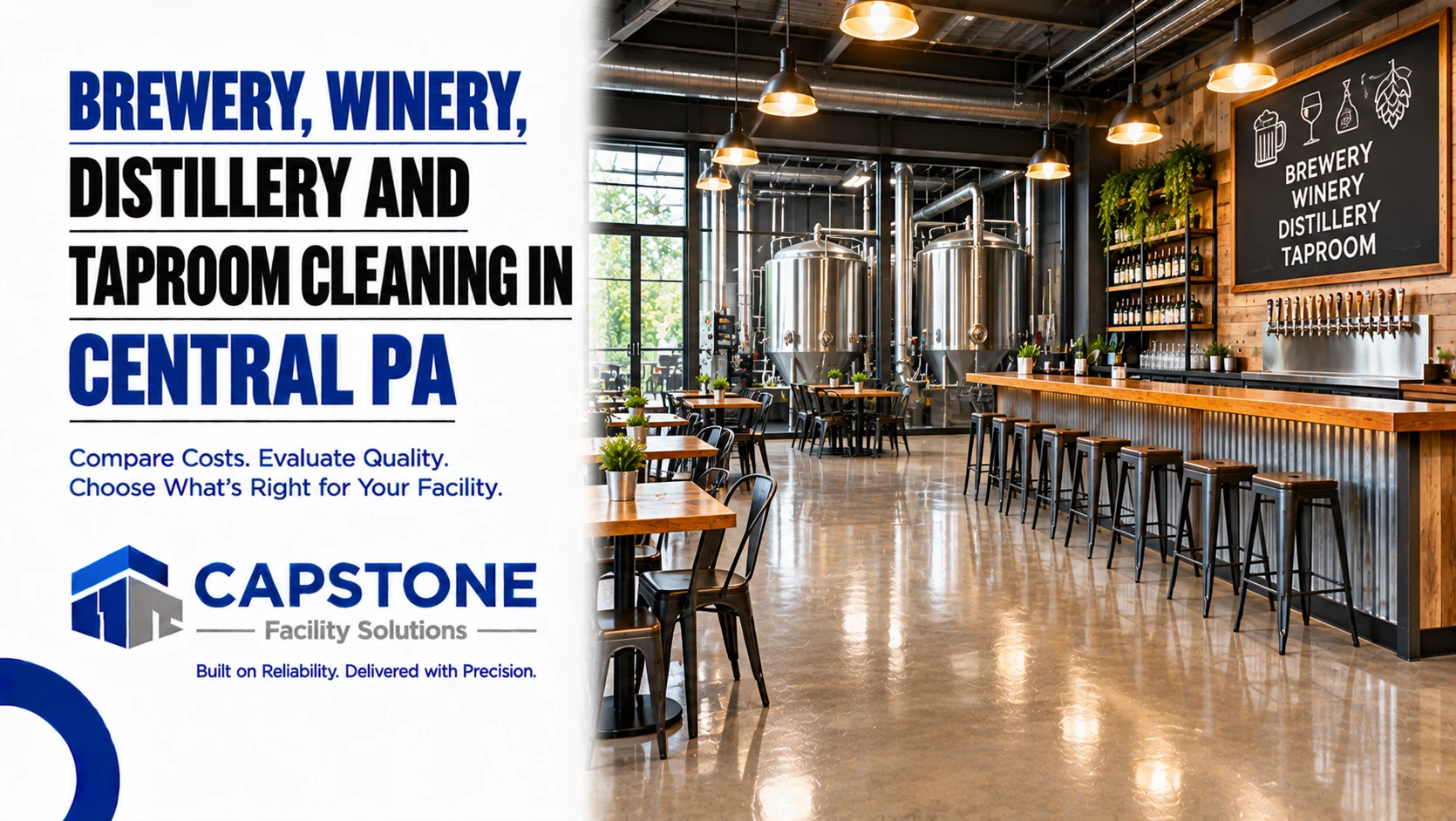
The floor is the first thing a customer notices and the last thing a tired staff cleans properly.
Why mops don’t fix it: a mop and bucket redistributes sugar as fast as it removes it. After a few passes the mop water is effectively thin beer, and the floor dries tacky again. A neutral or appropriate cleaner, mechanical agitation, and recovery of the dirty solution is what actually breaks the cycle — the same principle covered in our commercial floor care guide.
Sticky floors are also a slip and trip issue for staff carrying glassware and kegs, which matters as much as the impression on customers.
Behind-the-bar work — taps, draft lines, glass washers, coolers, and the back bar — stays with bar staff. That’s where product touches equipment, and it’s the brewery’s responsibility (see Section 3).
Exposed industrial ceilings look great in a taproom and collect dust and grease film faster than anyone notices. A periodic high-dusting pass keeps them from dropping debris onto tables.
Production areas need the boundary stated first.
What a cleaning contractor handles, when production isn’t running and with the brewer’s approval:
What stays with the brewer, winemaker, or distiller:
A cleaning contractor doesn’t sanitise product-contact equipment, and any vendor offering to “clean the tanks” has misunderstood how a brewery works. That’s the brewer’s sanitation program, and the beer depends on it. The same line is drawn in our manufacturing plant cleaning guide: environmental cleaning yes, process equipment no.
This is the detail most cleaning companies miss, and the one brewers and winemakers care about most.
Chlorine and beer. Chlorine-based cleaners like bleach can react with compounds in beer to form chlorophenols — off-flavours that taste medicinal or like plastic bandages at extremely low concentrations. Breweries generally keep chlorine products away from production for exactly this reason.
Chlorine and wine. Wineries have a related problem. Chlorine residues can contribute to TCA, the compound behind “cork taint,” which can affect barrels, corks, and cellar air. Many wineries ban chlorine-based cleaners from the cellar entirely.
What that means for a cleaning program:
A vendor who asks about your chemical restrictions on the first walkthrough understands the business. One who brings a bucket of bleach doesn’t.
Taproom restrooms take more traffic in one Saturday than many offices see in a week.
Restrooms are where reviews get specific. A taproom that keeps them clean through a busy Saturday — not just at close — earns a different reputation, which is why many breweries add a weekend day porter rather than relying on bar staff between pours.
Outdoor spaces are where Central PA taprooms make much of their summer revenue, and where spilled beer, food scraps, and sugar draw wasps and flies fastest. Weekend events in particular need a reset the next morning — the same turnover logic as our event venue cleaning guide.
The glass wall between the taproom and the brewhouse is the most photographed surface in many breweries. Smudges and condensation marks show up in every customer photo. Larger glass and exterior windows fit naturally into our commercial window cleaning program.
Craft beverage businesses run backwards compared with most commercial clients: busiest on Friday night and the weekend, quietest Monday through Wednesday.
Many taprooms are closed or quiet on Monday and Tuesday, which makes those the natural days for deep floor work and production-area cleaning. Brew days set the rest of the schedule — nothing in production happens without the brewer signing off.
Customers judge the product by the room. People can’t evaluate fermentation technique, but they can tell when a floor is sticky or a restroom is neglected — and that impression carries straight into how they rate the beer, wine, or spirits.
Fruit flies are a residue problem. Fruit flies in taprooms are drawn to sugar residue, floor drains, bar mats, and recycling bins. Consistent removal of that residue is what keeps them down. Persistent infestations are a matter for a licensed pest control provider, but cleaning is what stops them from having somewhere to breed.
Inspections still apply. Taprooms and tasting rooms that serve food are generally inspected as food establishments by the PA Department of Agriculture or a local health department. Front-of-house cleanliness, restrooms, and floors are visible to any inspector — covered in more depth in our restaurant health inspection checklist.
Wet floors are the real safety risk. Brewhouse floors are wet most of the working day, and staff move kegs, hoses, and hot liquids across them. Keeping drains clear and floors free of residue is the same housekeeping argument as in our OSHA floor safety guide.
Capstone Facility Solutions provides commercial cleaning services throughout Central Pennsylvania, including breweries, brewpubs, wineries, cideries, distilleries, and taprooms in Harrisburg, Hershey, Lebanon, Palmyra, and surrounding communities. For full-service kitchens and dining rooms, see our restaurant cleaning services.
We build the program around your hours, not ours: after-close taproom cleaning, a weekend day porter when Saturdays need it, and production-area floor work scheduled on non-brew days with your approval.
We respect the production boundary. Tanks, kegs, lines, and your sanitation program stay with your team. We agree on a chemical list with your brewer or winemaker before we start, and keep chlorine out of production and cellar areas.
Every team member is background-checked, and we carry general liability and workers’ compensation coverage with certificates provided on request. All work is backed by our 100% satisfaction guarantee, with no long-term contract required. See our full janitorial services programs.
By sweeping first, then machine scrubbing with an appropriate cleaner and recovering the dirty solution rather than mopping it around. Mops spread dissolved sugar back across the floor, which is why taproom floors dry tacky even after they’ve been mopped.
Generally not in production areas. Chlorine can form chlorophenol off-flavours in beer and contribute to TCA, or cork taint, in wineries. Most breweries and wineries restrict chlorine-based products, and a cleaning contractor should agree its chemical list with the head brewer or winemaker before starting.
By removing what attracts them: sugar residue on floors and bar fronts, build-up in floor drains, wet bar mats, and recycling bins. Consistent cleaning reduces them significantly. Persistent infestations should be handled by a licensed pest control provider.
No. Brewhouse vessels, fermenters, brite tanks, barrels, kegs, draft lines, and CIP systems are part of the brewery’s own sanitation program. A cleaning contractor handles floors, drains, walls, restrooms, offices, and customer areas.
Most taprooms use after-close cleaning several nights a week for floors, bar fronts, seating, and restrooms, plus weekly detailed floor work, monthly high dusting, and a weekend day porter during peak hours.
On non-brew days, with the brewer’s approval — often Monday or Tuesday when many taprooms are closed or quiet. Production-area work is always scheduled around the brew calendar.
Yes — tables, benches, umbrellas, patio sweeping, spill clean-up, litter collection, bin areas, and seasonal opening and closing cleans.
The customer side is similar, but chemical restrictions are often stricter. Wineries typically ban chlorine from cellars because of TCA risk, and tasting rooms should avoid fragranced products because aroma is part of the product.
Taproom hours, brew schedule, event bookings, and chemical restrictions all change the right scope — and the production boundary is something we’d rather agree on in person than assume.
Call Capstone Facility Solutions at 717-298-7157 to schedule a free assessment for your brewery, winery, or taproom.
Tell us about your facility and we will send a custom, no-obligation price — usually within a day.