Cleaning a manufacturing plant is not cleaning a warehouse with machines in it. A distribution center moves goods through open space on a predictable schedule. A plant runs equipment, generates its own debris, houses hundreds of workers across overlapping shifts, and frequently never fully stops.
It also has a harder boundary than most buildings. Production equipment, food-contact surfaces, and anything requiring a machine to be locked out belong to trained plant personnel under the facility’s own procedures. What a commercial cleaning contractor handles is the environment around that work — floors, break areas, locker rooms, offices, restrooms, and the overhead dust nobody has time to reach.
For manufacturers across Harrisburg, Lebanon, Hershey, Palmyra, and the surrounding corridors, the practical question isn’t whether a vendor can clean. It’s whether they can work safely inside a running plant, around shift changes, to a scope that respects where their work ends.
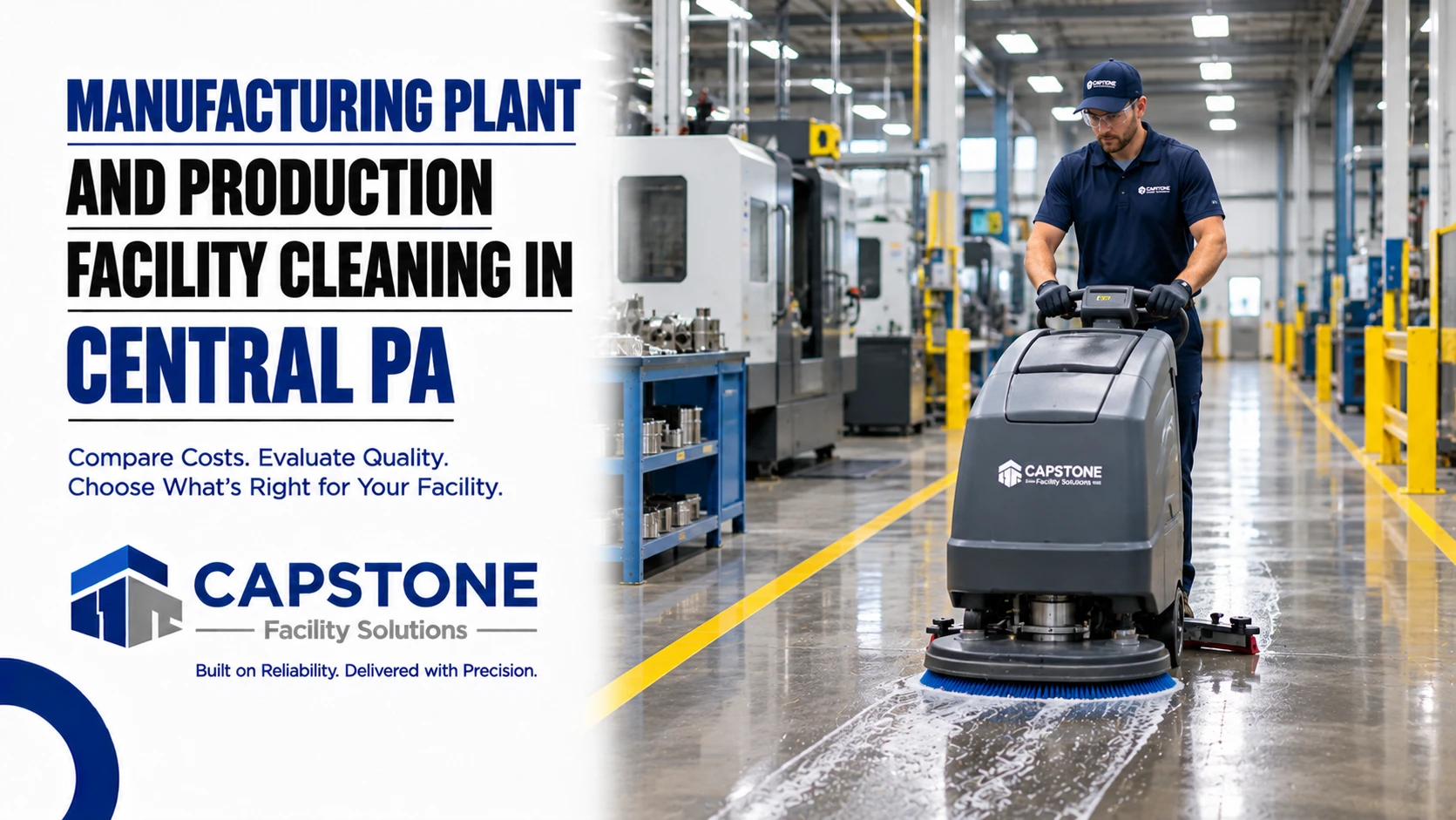
The plant floor is the largest surface in the building and the one that absorbs everything the process throws off.
Floor condition in a plant is a safety matter before it’s an appearance matter. Oil film, coolant residue, and accumulated dust create slip hazards in exactly the aisles where people walk between moving equipment and powered vehicles — the same housekeeping logic covered in our post on OSHA floor safety in warehouses.
Floors are usually sealed concrete or epoxy, chosen for washability. They need products compatible with the coating; harsh chemistry degrades sealant over time and leaves a porous surface that then holds contamination permanently.
Worth stating before anything else, because it’s how a plant manager judges whether a vendor understands the building.
A commercial cleaning contractor does not:
Those belong to trained plant personnel — maintenance, sanitation, or production staff — under the facility’s own procedures, training, and documentation.
What the contractor does handle is the environment: floors, aisles, equipment exteriors where the facility permits, break and locker areas, offices, restrooms, overhead dust on structures, and the general housekeeping that supports the plant’s own program rather than replacing it.
Food manufacturers in particular run their own sanitation programs under schemes that require trained, documented personnel. A cleaning contractor supports the non-production environment around those zones. Any vendor offering to “handle your plant sanitation” has misunderstood how the facility is regulated.
This is the work plants most often need and least often get to, because it requires time, access equipment, and a shutdown window.
Accumulated overhead dust in a production environment isn’t cosmetic. It falls onto product and work surfaces, it loads ventilation systems, and in facilities handling combustible dusts it’s a recognised hazard the plant’s own program will have requirements around.
High dusting generally needs a planned shutdown window — a holiday, a scheduled maintenance period, or a changeover — and is worth booking well ahead rather than attempting around running equipment.
Plants concentrate hundreds of people into break areas in tight windows, several times a day.
Frequency matters more than thoroughness here. A break room cleaned once overnight and then used by three shifts is unacceptable in a plant running around the clock. Most multi-shift facilities need break area attention between shifts, not just at the end of the day — which is where day porter coverage earns its place in an industrial setting.
Break areas are also the single most common source of employee complaints about facility conditions, which gives them outsized weight with plant HR and management.
Heavy-use facilities with concentrated demand at shift change.
Shift-change surges mean a restroom can take a full building’s daily use in twenty minutes. Restocking capacity, not just cleaning quality, is what determines whether it holds up — and the same mold and drain-maintenance logic applies in plant showers as in any wet area.
Most plants have a front office operating like any professional workplace, plus technical spaces with their own rules.
QC labs and technical spaces are typically limited scope — floors, general surfaces, and trash — with benches, instruments, samples, and anything process-related left to lab staff. As with any technical area, the facility defines the line at the walkthrough and it’s treated as fixed.
This is what separates a contractor a plant can use from one it can’t, and it’s usually the first thing an EHS manager asks about.
A cleaning contractor working in a production facility should expect:
A plant may also require contractor safety qualification, badge access, or sign-in procedures. A vendor who treats these as friction rather than normal practice is the wrong vendor for an industrial site.
Plant flooring is chosen for durability and takes constant chemical and mechanical exposure.
Aisle markings are the detail most often damaged by aggressive floor work. Losing them means repainting, which means a shutdown — so method matters more than machine power on a marked plant floor.
Plants rarely offer the empty-building window most commercial cleaning assumes.
The practical requirement is a vendor who can commit to shift-aligned schedules and hold them. A plant running three shifts cannot absorb a crew that shows up when convenient — the break room has to be turned between shifts, not whenever the night is quiet.
Booking shutdown work early matters on both sides. Holiday and maintenance windows are the only time some of this work can happen, and capacity fills.
Safety. Floor condition, clear aisles, unobstructed egress, and controlled dust are direct safety factors in an environment with powered equipment and moving machinery. Housekeeping is part of how a facility manages that, and a contractor’s work either supports the plant’s program or undermines it.
Equipment and facility life. Dust loads ventilation and electrical equipment. Degraded floor sealant becomes porous and holds contamination. Deferred cleaning turns into capital expense.
Audits and visits. Manufacturers host customer audits, certification visits, and prospective-client tours. A plant that’s consistently clean isn’t scrambling the week before one, and a visibly well-kept facility signals operational discipline to a customer evaluating a supplier.
Workforce. Break rooms, locker rooms, and restrooms are what employees judge a facility on, and manufacturing labour markets in Central PA are competitive. Conditions in those spaces show up in retention conversations more often than management expects.
Capstone Facility Solutions provides commercial cleaning services throughout Central Pennsylvania, including manufacturing and production facilities in Harrisburg, Lebanon, Hershey, Palmyra, and surrounding communities. We also serve warehouse and distribution operations across the region — see our warehouse cleaning programs.
We work inside your safety program, not around it: site orientation before the first shift, PPE to your requirements, no interference with equipment or controls, and prompt reporting of anything unsafe. We build schedules that align to your shifts rather than our convenience, and we book shutdown work ahead so high dusting and deep floor projects actually happen.
We’re clear about where our scope ends. Production equipment, food-contact sanitation, lockout/tagout work, and regulated waste stay with your trained personnel — and we’ll say so plainly rather than overselling what a cleaning contractor should be doing in a plant.
Every team member is background-checked, and we carry general liability and workers’ compensation coverage with certificates provided on request. All work is backed by our 100% satisfaction guarantee, with no long-term contract required. See our full janitorial services programs.
Production floor environmental cleaning and degreasing, aisle and walkway cleaning, debris removal, high dusting of overhead structures, break rooms and cafeterias, locker rooms and restrooms, plant offices and administrative areas, and periodic floor projects. Production equipment and regulated sanitation remain with plant personnel.
No. Production equipment, machine interiors, anything behind a guard, and any task requiring lockout/tagout belong to trained plant personnel under the facility’s own procedures. A commercial cleaning contractor handles the environment around the equipment.
Yes. Continuous plants are cleaned zone by zone around running production, with break areas and locker rooms turned between shifts and deeper floor work scheduled for off-shift periods or planned shutdowns.
Most plants need daily sweeping and debris removal, with machine scrubbing and degreasing on a frequency set by the process and the soil it generates. Facilities with oil, coolant, or heavy particulate typically need more frequent attention than dry assembly operations.
The facility’s own requirements govern: site-specific orientation before the first shift, PPE appropriate to each area, awareness of powered equipment traffic, no interference with machinery or controls, and compliance with any contractor qualification or sign-in program.
No. Food-contact sanitation in regulated production zones is performed by the facility’s trained sanitation personnel under its own program. A cleaning contractor supports the non-production environment — offices, break areas, locker rooms, restrooms, and general housekeeping outside those zones.
During a planned shutdown, holiday period, or maintenance window, since overhead work generally requires access equipment and a halt to production below. These windows fill up, so booking well ahead is worth doing.
These are standard contractor scope and usually the highest-frequency item in a multi-shift plant, often needing attention between shifts rather than once overnight.
Every facility divides this work differently depending on process, shift pattern, and in-house staffing. A walkthrough with your operations or EHS lead settles the scope, the schedule, and the safety requirements in one visit.
Call Capstone Facility Solutions at 717-298-7157 to schedule a free assessment for your plant.
Tell us about your facility and we will send a custom, no-obligation price — usually within a day.