A veterinary practice is one of the harder commercial buildings to clean well. It handles patients who shed, scratch, and occasionally have accidents on the floor; it manages pathogens that survive on surfaces for months; and it has an odor problem that no other healthcare setting has to solve.
It also has a constraint most cleaning contractors have never encountered: some common commercial disinfectants are genuinely dangerous to animals. A product that’s routine in an office can be toxic to a cat. That single fact disqualifies a lot of otherwise capable cleaning crews.
For veterinary practices, animal hospitals, and boarding facilities across Harrisburg, Hershey, Lebanon, and Palmyra, a professional cleaning program handles the environmental work — floors, surfaces, waiting areas, ward and kennel spaces — using products and methods appropriate to a building full of animals, and within the protocol the practice has already established.
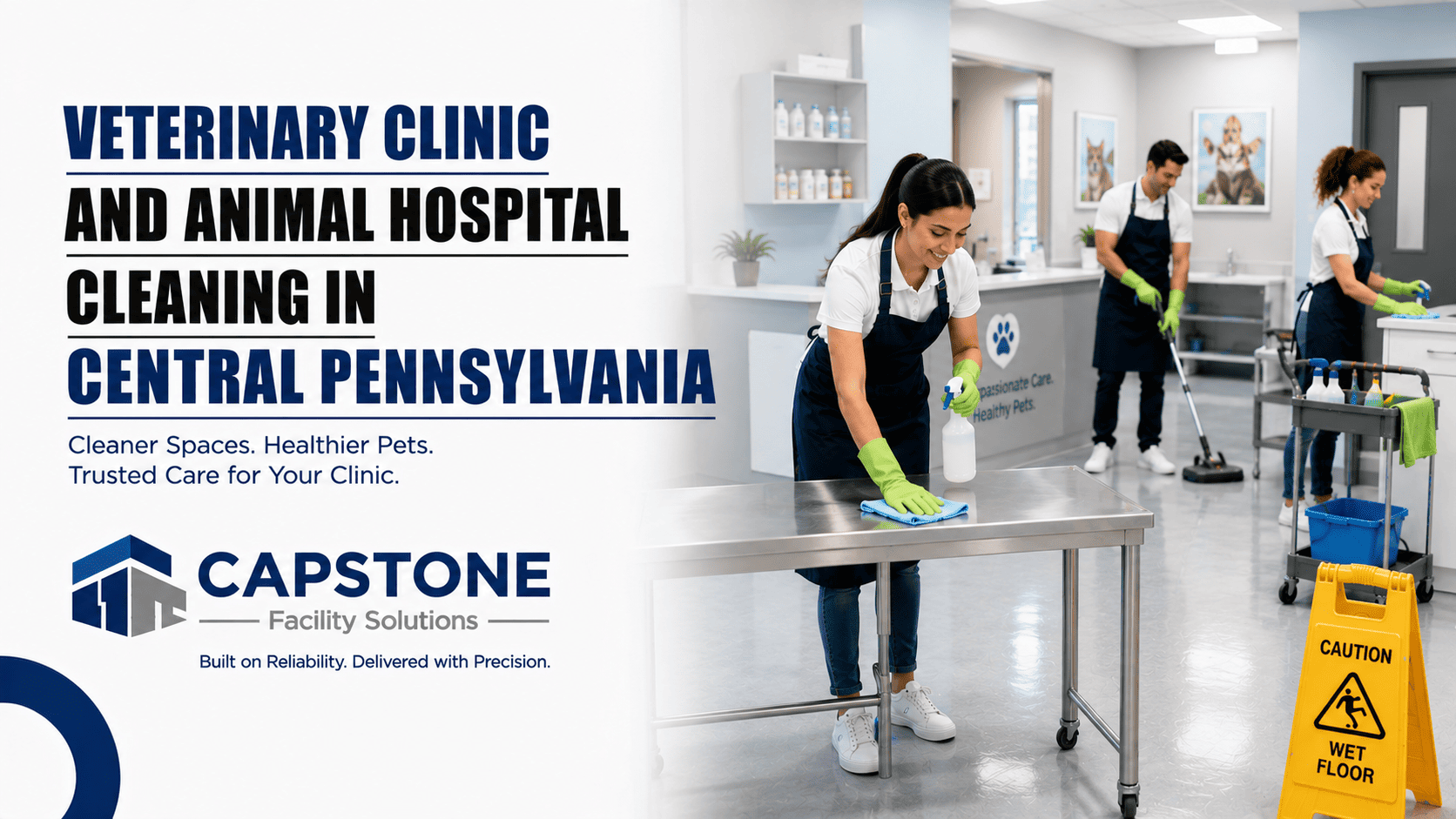
The waiting room is where clients form their impression, and it’s also where a lot of animals arrive stressed, shedding, and occasionally incontinent.
Hair is the defining challenge here. Standard vacuuming isn’t enough in a veterinary waiting room — hair works into seat seams, baseboards, and corners, and needs deliberate attention rather than a pass with an upright.
Exam rooms turn over constantly, and staff disinfect exam surfaces between patients as part of clinical protocol. The cleaning program handles the thorough environmental work around that:
Scope boundary: clinical surface disinfection between patients, instrument handling, sharps containers, and regulated medical waste remain with trained staff under the practice’s protocol. The cleaning program handles environmental surfaces.
These are the practice’s most controlled spaces, and the cleaning role is narrower and more carefully bounded:
Surgical suite work is scheduled when procedures aren’t in progress, and always to the practice’s specification. Instrument reprocessing, autoclave operation, sterile field preparation, and clinical contact-surface disinfection are staff responsibilities — a cleaning contractor claiming otherwise should be a red flag.
This is the most physically demanding part of a veterinary cleaning scope and the part that determines whether the whole building smells acceptable.
Kennel floors are usually sealed concrete or epoxy specifically because they’re washed constantly. They need cleaning products compatible with that coating — harsh chemistry degrades sealant over time and creates a porous surface that then holds odor permanently, which is an expensive problem to reverse.
Drains are the single most under-attended source of persistent odor in a veterinary building. A facility that smells despite thorough surface cleaning usually has a drain problem, not a cleaning problem.
Isolation wards exist precisely because of pathogen control, and cleaning them follows the practice’s protocol rather than a generic routine.
In most practices, isolation cleaning stays entirely with clinical staff, who are trained on the specific protocol for the pathogen involved and on the PPE required. Where a cleaning contractor is involved at all, it’s under explicit written direction from the practice covering products, contact times, sequence, and PPE.
The correct position for a cleaning contractor is to follow the practice’s protocol exactly or to stay out of the area entirely — never to improvise. Any contractor who proposes handling isolation cleaning to their own standard has misunderstood the risk.
This is what most separates veterinary cleaning from other commercial work, and the reason product choice can’t be left to habit.
Phenolic disinfectants are toxic to cats. Cats lack an enzyme pathway that other species use to metabolize phenolic compounds, which makes exposure genuinely dangerous. Phenolics are common in general commercial disinfectants — which means a contractor using their standard product in a feline area is creating a real hazard, not a theoretical one.
Quaternary ammonium compounds are widely used in veterinary settings and effective against many pathogens, but they have known gaps — notably, they are not reliably effective against non-enveloped viruses like parvovirus.
Parvovirus requires specific chemistry. It is extraordinarily durable, surviving on surfaces for months and resisting many routine disinfectants. Practices use specific products — commonly dilute bleach or accelerated hydrogen peroxide — at specific concentrations and contact times for parvo protocols. A contractor should never substitute a product in an area where a parvo protocol applies.
Contact time governs everything. Every disinfectant has a labelled wet-contact time, and a surface wiped dry in ten seconds hasn’t been disinfected regardless of the product used. This is the most common failure in practice, and it’s a technique problem rather than a product problem.
Residue matters more here. Animals lick surfaces, walk on floors and then groom their paws, and lie directly on cleaned surfaces. Products that require rinsing must actually be rinsed.
The practical conclusion: the practice specifies the products, and the cleaning contractor uses them correctly. A veterinary practice manager knows their disinfectant protocol far better than any cleaning company does. The contractor’s job is to follow it precisely, understand why the constraints exist, and not substitute products for convenience or cost.
Odor is the complaint veterinary practices hear most from clients, and masking it never works — animals and humans both detect the underlying source through fragrance.
The actual sources:
Control means removing sources: thorough drain cleaning and flushing on a schedule, maintaining floor sealant so surfaces stay non-porous, tightening waste handling cycles, deep-cleaning soft surfaces, and confirming ventilation is working. Persistent odor after all of that usually indicates a flooring or ventilation problem the building needs to solve, not a cleaning frequency problem.
Veterinary flooring is chosen for washability and takes constant chemical exposure:
Each needs products compatible with the surface. The general rule is neutral-pH cleaners for routine work with disinfection appropriate to the area, and avoiding chemistry that degrades sealants and coatings. Damaged sealant on a kennel floor turns a washable surface into an absorbent one, which is the fastest route to a permanent odor problem. Periodic commercial floor care keeps those surfaces intact.
Practices run long days, and emergency and specialty hospitals never close:
Boarding is the scheduling complication most contractors miss. A practice may close at 6pm Friday but still have animals on site all weekend, which means the kennel scope doesn’t follow the clinic’s hours.
Three reasons, in order of seriousness.
Pathogen control. Veterinary practices concentrate sick animals in a shared space. Parvovirus, feline calicivirus, kennel cough, ringworm, and others transmit through contaminated environments, and some persist on surfaces for months. Environmental cleaning is a genuine control measure, and it’s also where zoonotic risk to staff and clients is managed.
Client perception. Pet owners are, if anything, more attentive to cleanliness at their vet than at their own doctor. A visibly dirty waiting room or a building that smells makes clients question the standard of care their animal is receiving — fairly or not.
Facility preservation. Veterinary buildings take chemical and biological abuse continuously. Floor sealants, grout, and coatings degrade under the wrong products, and once a kennel floor becomes porous, the odor and contamination problems become structural rather than cleanable.
Capstone Facility Solutions provides commercial cleaning services throughout Central Pennsylvania, including veterinary practices, animal hospitals, and boarding facilities in Harrisburg, Hershey, Lebanon, Palmyra, and surrounding communities. We also serve human healthcare facilities across the region — see our medical office cleaning programs.
We work within your practice’s established disinfectant protocol rather than substituting our own products, observe labelled contact times rather than wiping and moving on, and build the scope around your building’s actual layout — including boarding areas that don’t follow clinic hours. Every team member is background-checked and trained before working in an occupied clinical facility, and we carry general liability and workers’ compensation coverage.
We handle environmental cleaning. Instrument sterilization, regulated medical waste, sharps, and isolation protocol stay with your clinical staff, where they belong — and we’ll say so plainly rather than overselling the scope.
All work is backed by our 100% satisfaction guarantee, with no long-term contract required.
It depends on the area and the pathogens of concern, which is why practices specify their own protocol. Two constraints matter most: phenolic disinfectants are toxic to cats and should not be used in feline areas, and quaternary ammonium products are not reliably effective against parvovirus. A cleaning contractor should use the practice’s specified products rather than substituting.
No. Cats lack a metabolic pathway that other species use to process phenolic compounds, which makes exposure genuinely dangerous. Phenolics are common in general commercial disinfectants, so this is a real risk when a contractor uses standard office products in a veterinary building.
Parvovirus is highly durable and resists many routine disinfectants, surviving on surfaces for months. Practices use specific products — commonly dilute bleach or accelerated hydrogen peroxide — at defined concentrations and contact times. A cleaning contractor should follow the practice’s parvo protocol exactly and never substitute a product.
By removing sources rather than masking them. The most common are floor drains, degraded or porous flooring, kennel surfaces at animal height, waste and laundry areas, and inadequate ventilation. Persistent odor after thorough cleaning usually indicates a flooring or ventilation issue rather than a cleaning frequency issue.
Yes. Kennel cleaning covers floors and drains, cage exteriors and surrounding surfaces, walls at animal height, waste removal and container sanitizing, and hardware disinfection — using products compatible with sealed concrete and epoxy coatings.
Isolation cleaning generally stays with clinical staff trained on the specific protocol and PPE for the pathogen involved. Where a contractor is involved, it is only under explicit written direction from the practice. Improvising in an isolation area is not acceptable.
No. Regulated medical waste, sharps, instrument reprocessing, and sterile processing remain the responsibility of trained clinical staff. The cleaning program handles environmental surfaces, floors, and general waste.
Yes. Emergency and specialty hospitals are cleaned around active operations rather than after close, which requires crews comfortable working in occupied clinical space. Boarding areas are typically scheduled separately from clinic hours, since animals remain on site through weekends.
Every practice has a different layout, patient mix, boarding setup, and disinfectant protocol — which is what determines the right scope and schedule.
Call Capstone Facility Solutions at 717-298-7157 to schedule your free on-site assessment and receive a cleaning plan built around your practice’s protocol and hours.
Tell us about your facility and we will send a custom, no-obligation price — usually within a day.