
Most commercial buildings in Central Pennsylvania take more floor damage between December and March than in the other nine months combined. Not from traffic — from what that traffic carries in.
Road salt, ice melt, sand, and slush get tracked through the entrance on every shoe, then ground into the floor by everyone who follows. Salt residue leaves a white haze that ordinary mopping doesn’t remove because it keeps redepositing. Grit acts as sandpaper under every footstep. And wet entryways become the single largest slip-and-fall exposure a building has all year.
The buildings that come through winter looking fine aren’t cleaning more often. They’re intercepting the problem at the door, using the right chemistry on the residue, and treating entryways as a daily task rather than part of the general routine.
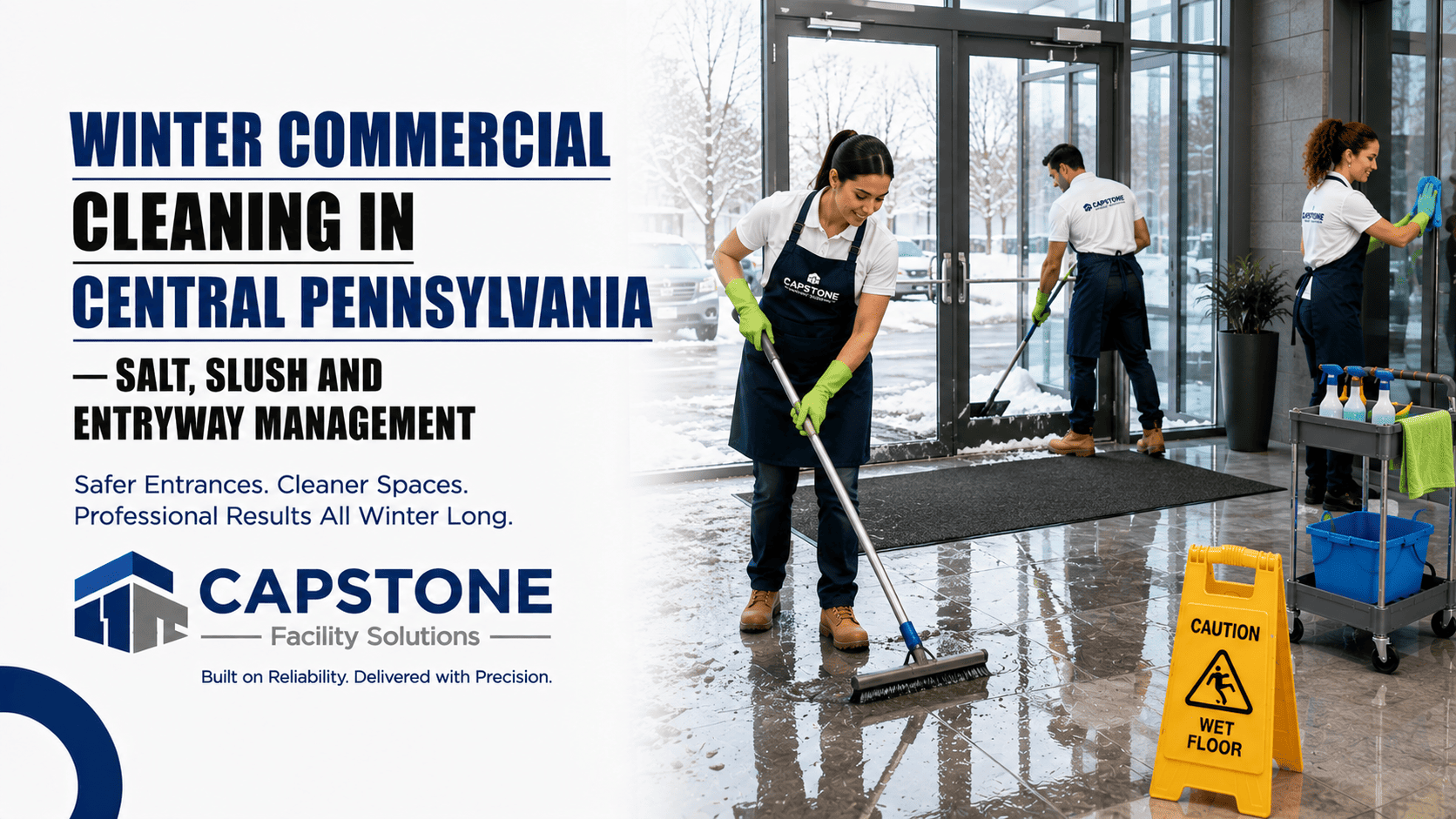
Three separate mechanisms, running simultaneously for four months.
Abrasion. Salt crystals and sand are hard, angular particles. Every footstep grinds them into the floor surface. On finished floors that means the finish wears through in traffic lanes; on tile it dulls the surface; in carpet it cuts the fibres from the base up, which is why winter-damaged carpet looks worn rather than dirty.
Chemical residue. Salt doesn’t rinse away like dirt. It dissolves, spreads across a wider area, and recrystallises as the floor dries — which is why a mopped floor can look worse an hour later. The white haze is salt that was redistributed rather than removed.
Moisture. Constant wetting keeps floors damp for hours, works into grout and seams, and creates the conditions for slips. On sealed surfaces it can lift finish; on carpet it holds soil in place and produces odor.
The compounding effect is what does the real damage. A floor that’s abraded is more porous, a more porous floor holds more residue, and residue accelerates further wear. By March, a building that didn’t manage it is looking at refinishing rather than cleaning.
If a building does only one thing differently in winter, it should be matting — it’s cheaper than every other intervention and prevents more damage than all of them combined.
The principle is walk-off distance. Soil and moisture come off shoes progressively, over a number of steps. Short mats intercept a fraction; adequate matting intercepts most of it.
A proper system has three stages:
Most commercial buildings run far too little matting. The common setup — one three-by-five mat inside the door — intercepts roughly two steps’ worth. Getting most of the salt and moisture off a shoe takes considerably more distance than that. Winter is worth extending the matting run substantially, even temporarily.
Matting only works if it’s maintained. A saturated mat stops absorbing and starts redistributing, and a mat full of salt is a source rather than a barrier. In heavy weather that means vacuuming or swapping mats daily, sometimes more than once.
The entrance becomes the highest-frequency cleaning area in the building from December through March. Daily and intra-day work includes:
This is the clearest case in the calendar for day porter coverage. A single overnight visit cannot address an entryway that’s re-soiled continuously from 8am onward, and the gap between clean-at-6am and hazardous-at-2pm is where both the damage and the liability accumulate.
Salt requires different chemistry than ordinary soil, which is why standard mopping makes it look worse.
Salt residue is alkaline. Neutral or alkaline cleaners dissolve and spread it, and it recrystallises as the floor dries — the white haze. Removing it needs a neutralizing cleaner formulated for salt, which is mildly acidic and chemically converts the residue so it can be removed rather than redistributed. Practical points:
Untreated salt haze becomes permanent. Left through a full winter, salt penetrates finish and grout to a point where cleaning won’t recover it and refinishing becomes the only option — which is why spring is when so many buildings discover they need floor stripping and refinishing.
Winter entryways are the highest slip-risk area a commercial building has, and the exposure is real regardless of how the accident is ultimately apportioned.
Reasonable practice:
The last point is the one buildings most often lack. If the answer to “who deals with a wet entrance at 11am” is “whoever notices,” in practice it’s nobody until someone falls. The same housekeeping principle applies here as in warehouse floor safety — the control is a defined responsibility, not general good intentions.
What goes down outside determines a good deal of what happens inside.
Two practical points that matter more than product choice:
Over-application is the main problem. Most buildings use several times more ice melt than needed. Excess doesn’t melt more ice — it sits on the surface and gets tracked directly inside. Correct application rates reduce both cost and interior damage.
Coordinate with your snow contractor. Facility managers often have no idea what product is being applied to their own entrances. Since it directly determines the interior residue problem, that’s worth a conversation before the first storm rather than after.
Where a building has specific flooring — polished concrete, certain epoxies, natural stone — the flooring manufacturer’s guidance should govern which products are acceptable near the entrance.
Winter isn’t the season to run the same scope you run in July. A sensible seasonal adjustment:
That last point is worth stating to clients directly: refinishing a floor in January is largely wasted money. Winter is for protection; spring is for restoration, which is what our post on spring deep cleaning covers.
The costs are mostly deferred, which is why they get ignored until spring.
Accelerated floor replacement. Carpet worn down by four months of grit doesn’t recover with cleaning. Finished floors that lose their coating in traffic lanes expose the tile beneath to direct wear. Both convert a maintenance expense into a capital one.
Refinishing that could have been avoided. A building that manages salt properly can often stretch a floor another year. One that doesn’t will need a full strip and refinish every spring, which is a substantial recurring project cost.
Slip-and-fall exposure. A single incident in an unmanaged entryway can cost more than years of enhanced winter cleaning, before considering the operational disruption.
Appearance during the season clients are inside. People spend more time indoors in winter and notice the building more. A hazed lobby and permanently damp entrance are visible for four straight months.
Set against that, the winter interventions are inexpensive — more matting, correct chemistry, and increased entryway frequency. It’s one of the clearest cost-avoidance cases in facility maintenance.
Capstone Facility Solutions provides commercial cleaning services throughout Central Pennsylvania, serving offices, medical practices, dealerships, schools, retail, and multi-tenant buildings in Harrisburg, Hershey, Lebanon, Palmyra, and surrounding communities — through Central PA winters every year.
We adjust scope seasonally rather than running a fixed program year-round: increased entryway frequency during weather, dedicated salt neutralizer treatment on entry-adjacent flooring, matting maintenance, and daytime coverage where an overnight visit can’t keep up. We’ll also tell you when it makes more sense to defer refinishing until spring than to do it in February and watch it undone.
Winter scope adjustments can generally be added to an existing program rather than renegotiated as a separate contract. See our janitorial services programs, or read what to look for in a commercial cleaning contract if you’re comparing vendors.
All work is backed by our 100% satisfaction guarantee, with no long-term contract required.
Salt residue is alkaline, so it needs a neutralizing cleaner — mildly acidic and formulated for salt removal — rather than general-purpose cleaner, which dissolves and redistributes it. Change mop water frequently, rinse thoroughly, and address residue promptly before it works into grout and finish. On carpet, extract rather than surface-clean.
That haze is salt residue that was spread rather than removed, recrystallising as the floor dries. It’s a sign the wrong cleaning chemistry is being used. Left untreated through a full winter, it can penetrate finish and grout to the point that refinishing becomes the only fix.
It can, both chemically and through abrasion. Rock salt is the most aggressive toward concrete and floor finishes; calcium chloride works at lower temperatures but tends to leave an oily interior residue. Over-application is usually a bigger problem than product choice, since excess material gets tracked straight inside.
More than most have. Soil and moisture come off shoes progressively over multiple steps, so a single mat inside the door intercepts only a fraction. A three-stage system — exterior scraper, interior scraper-wiper, then absorbent matting — with a meaningful walk-off distance is far more effective, and worth extending temporarily for winter.
During active weather, multiple times daily. A single overnight visit cannot keep up with an entrance that’s re-soiled continuously through the day, which is why many buildings add daytime porter coverage for the season.
Wait, in most cases. Refinishing in January means the new finish immediately takes a full remaining season of salt and grit. Winter is for protection; spring, once salt season ends, is when refinishing holds.
Generally not during freezing conditions, since cleaning solution can freeze on the glass. Interior glass can be cleaned year-round, so winter is a good time to schedule partitions, lobbies, and conference room glass.
The interventions that work in winter — adequate matting, the right chemistry, increased entryway frequency — need to be in place before the weather arrives, not after the damage starts showing.
Call Capstone Facility Solutions at 717-298-7157 to schedule your free walkthrough and get a winter scope recommendation for your building.
Tell us about your facility and we will send a custom, no-obligation price — usually within a day.