A senior living community is a workplace, a healthcare setting, and several hundred people’s home at the same time. That last part changes the job more than anything else.
Cleaning happens around residents who live there — many with mobility limitations, some with cognitive impairment — in spaces they use continuously. There’s no after-hours window in the way an office has one. A wet floor is a fall risk for a population where falls have serious consequences. And a congregate residential setting concentrates infection risk in ways that make the choice of disinfectant a genuine clinical matter, not a purchasing preference.
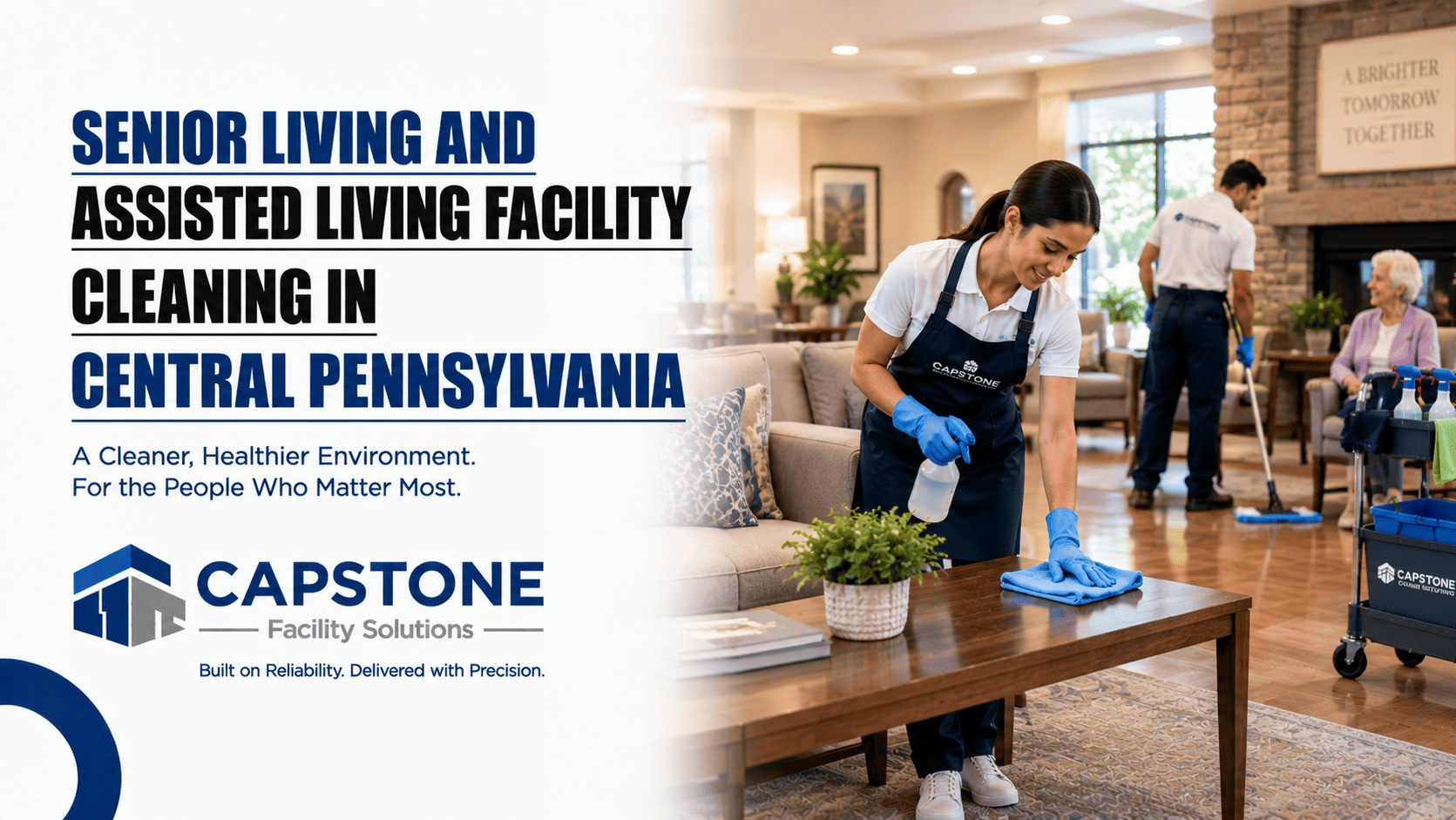
For communities across Harrisburg, Hershey, Lebanon, and Palmyra — assisted living, personal care, memory care, independent living, and continuing care campuses — cleaning support means working alongside a facility’s own environmental services team on common areas, dining rooms, and public spaces, to that facility’s protocol and standards.
This matters enough to state before anything else, because getting it wrong wastes an administrator’s time.
Licensed senior care facilities have their own housekeeping and environmental services staff. Much of the cleaning in these buildings — resident rooms, personal care areas, anything clinical, medical waste, and outbreak response — is performed by trained facility employees under the facility’s own protocols and regulatory obligations. That’s not work a general cleaning contractor takes over.
Where a commercial cleaning partner typically fits:
Independent living campuses often outsource more broadly, since the regulatory framework is lighter than in skilled nursing. Skilled nursing and memory care typically outsource the least. Most communities land somewhere in between, and the right split is a conversation with the administrator rather than something to assume.
These are the spaces residents move through all day, and they carry both the appearance and the safety load.
Wet floors are handled differently here than anywhere else. In a building where a fall can mean a hospitalization, floor cleaning is planned to keep surfaces dry and passable — working in sections, using minimal-moisture methods where appropriate, signing clearly, and never leaving a wet area unattended in a corridor residents use. This is a real operational constraint, not a caution to be noted and forgotten.
Dining spaces run two or three services a day, every day, with tight turnarounds and a resident population for whom mealtimes are a fixed part of the routine.
The kitchen itself is typically the facility’s dietary department, with its own staff and standards. The contractor’s role is generally front of house, coordinated around service times — and the timing coordination is the harder part of the job.
Congregate residential settings concentrate infection risk, and this is where a contractor’s knowledge is either an asset or a liability.
Two facts drive most of it:
Clostridioides difficile (C. diff) forms spores that resist many routine disinfectants. Standard quaternary ammonium products and alcohol-based products do not reliably kill C. diff spores. Facilities use EPA-registered sporicidal products — commonly bleach-based — at defined concentrations and contact times for C. diff protocols.
Norovirus is similarly durable. It resists many common disinfectants and spreads rapidly in congregate settings, which is why facilities keep specific outbreak protocols rather than relying on routine cleaning products.
Contact time governs everything. A disinfectant only works if the surface stays visibly wet for the labelled dwell time. A wipe that dries in ten seconds has not disinfected anything — the most common failure in practice, and a technique issue rather than a product one.
The practical position for a contractor: the facility specifies the products and protocols, and the contractor follows them exactly. An infection preventionist or director of nursing knows the facility’s protocol far better than any cleaning company does. The contractor’s job is to use what’s specified, observe contact times, understand why the constraints exist, and never substitute a product for cost or convenience.
During an active outbreak, enhanced protocols typically move to trained facility staff, and any contractor role is under explicit written direction. Improvising during an outbreak is not acceptable in a building full of medically vulnerable residents.
The touch-point map differs from an office building:
Handrails deserve particular attention. In an office building they’re incidental; here, nearly every resident uses them multiple times daily, which makes them among the most consequential surfaces in the building.
This is the part that most distinguishes senior living work from other cleaning, and it’s the part administrators evaluate hardest.
A crew that’s good at this is worth considerably more to a community than one that simply cleans well, and administrators can tell the difference within a week.
Screening requirements for people working in facilities serving older adults are more stringent than in general commercial work, and they vary by facility type and role.
What a community should expect:
The facility’s requirements govern here, not the vendor’s standard practice. A cleaning company working in senior living should ask what screening the community requires and meet it — including anything beyond their normal process — rather than assuming their usual checks suffice.
Consistency of crew matters more here than in most settings. Residents notice and are reassured by familiar faces, and staff turnover in a resident-facing role is genuinely disruptive.
Odor is a persistent concern in senior living and one that administrators are acutely aware of, since it shapes family impressions on tours more than almost anything else.
Sources are generally environmental rather than cleaning-frequency related:
Control means removing sources — carpet extraction on a proper cycle, maintaining flooring so it stays non-porous, tighter waste handling, and confirming ventilation works. Masking with fragrance is counterproductive and, in a building where residents may have respiratory sensitivities, sometimes actively unwelcome.
Persistent odor after thorough cleaning usually indicates a flooring, ventilation, or building issue rather than a cleaning problem — and saying so plainly is more useful to an administrator than promising a product will fix it.
These buildings never close, which removes the after-hours window most commercial cleaning depends on.
Project work needs more lead time here than anywhere else. Closing a corridor or a dining room affects residents’ daily routines, and communities plan those disruptions carefully with notice to residents and families.
Resident health. Congregate residential settings concentrate people who are older, often medically complex, and more vulnerable to infection. Environmental cleaning is a genuine control measure in that context, not a matter of appearance.
Fall prevention. Wet floors, obstructed corridors, and equipment left in walkways are direct hazards in a population where falls frequently mean hospitalization and lasting decline. How cleaning is performed matters as much as whether it’s done.
Family impressions and census. Families touring on behalf of a parent notice cleanliness and odor before they notice anything else, and they are choosing among communities. Building condition affects occupancy in a directly measurable way.
Regulatory standing. Licensed facilities are inspected, and sanitation is part of what’s reviewed. A community maintaining consistent standards isn’t scrambling before a survey.
It’s people’s home. A resident may live in the building for years. The standard that’s appropriate is the one you’d want for a family member’s home, which is a higher bar than most commercial cleaning is held to.
Capstone Facility Solutions provides commercial cleaning services throughout Central Pennsylvania, including senior living and assisted living communities in Harrisburg, Hershey, Lebanon, Palmyra, and surrounding communities. We also serve human healthcare facilities across the region — see our medical office cleaning programs.
We work within your facility’s protocols and product specifications rather than substituting our own, observe labelled contact times, and build the scope around your meal and activity schedule rather than our convenience. We meet the screening requirements your community sets, including enhanced requirements beyond our standard process, and we keep crews consistent so residents see familiar faces.
We’re clear about where we fit. Common areas, dining spaces, public and administrative areas, and periodic project work are ours. Resident care, clinical cleaning, medical waste, and outbreak protocol execution stay with your trained staff — and we’ll say so rather than overselling the scope.
We carry general liability and workers’ compensation coverage, provide certificates of insurance on request, and work without long-term contract requirements. Every program is backed by our 100% satisfaction guarantee.
Typically common and public areas, corridors, lounges and activity rooms, dining and café spaces front of house, administrative offices, public restrooms, wellness and therapy areas, and periodic project work such as floor refinishing and carpet extraction. Resident care, clinical cleaning, medical waste, and outbreak protocol execution remain with trained facility staff.
Clostridioides difficile forms spores that resist many routine disinfectants, including standard quaternary ammonium and alcohol-based products. Facilities use EPA-registered sporicidal products, commonly bleach-based, at defined concentrations and contact times. A cleaning contractor should use the facility’s specified product and protocol rather than substituting.
By following the facility’s guidance. Residents may be confused by unfamiliar equipment or distressed by disruption, so crews work with minimal noise where possible, remain calm and courteous, and involve facility staff rather than attempting to manage a distressed resident themselves.
Common areas and corridors generally need daily attention, dining rooms between every service, and high-touch surfaces such as handrails and elevator buttons multiple times daily. Periodic work like carpet extraction and floor refinishing runs on a scheduled cycle planned around resident routines.
Screening requirements for facilities serving older adults are more stringent than general commercial work and vary by facility type. The community’s requirements govern, and a cleaning contractor should meet them — including anything beyond their standard process — with documentation kept current.
Largely, with planning. Work is scheduled around meals, activities, and therapy sessions; corridors are done in sections to keep paths clear and dry; and disruptive equipment is used at appropriate times. Project work is planned well in advance with notice to residents and families.
By addressing sources rather than masking them — carpet extraction on a proper cycle, maintaining flooring so it stays non-porous, tighter waste and linen handling, and confirming ventilation works. Fragrance masking is counterproductive and can be unwelcome for residents with respiratory sensitivities.
Enhanced outbreak protocols are typically executed by trained facility staff. Any contractor role during an outbreak is under explicit written direction from the facility, following their specified products, sequence, and PPE.
Every community divides this work differently, and the right scope depends on your facility type, your environmental services staffing, and your schedule.
Call Capstone Facility Solutions at 717-298-7157 to schedule a free walkthrough and a scope recommendation built around how your community actually runs.
Tell us about your facility and we will send a custom, no-obligation price — usually within a day.