Property managers do not really buy cleaning. They buy the absence of problems — no tenant emails about the restroom on three, no leasing tour walking past a dusty lobby, no scramble to find a certificate of insurance when the owner asks for one.
That makes multi-tenant cleaning a different job from cleaning a single office. The work happens across shared spaces nobody individually owns, gets billed back through CAM charges that tenants scrutinize, and has to be done by a crew that can be trusted with after-hours access to an occupied building.
For property managers running office buildings, professional plazas, and mixed-use properties across Harrisburg, Hershey, Lebanon, and Palmyra, the right cleaning partner is the one who understands the reporting, the access control, and the tenant-relations side of the job — not just the mop.
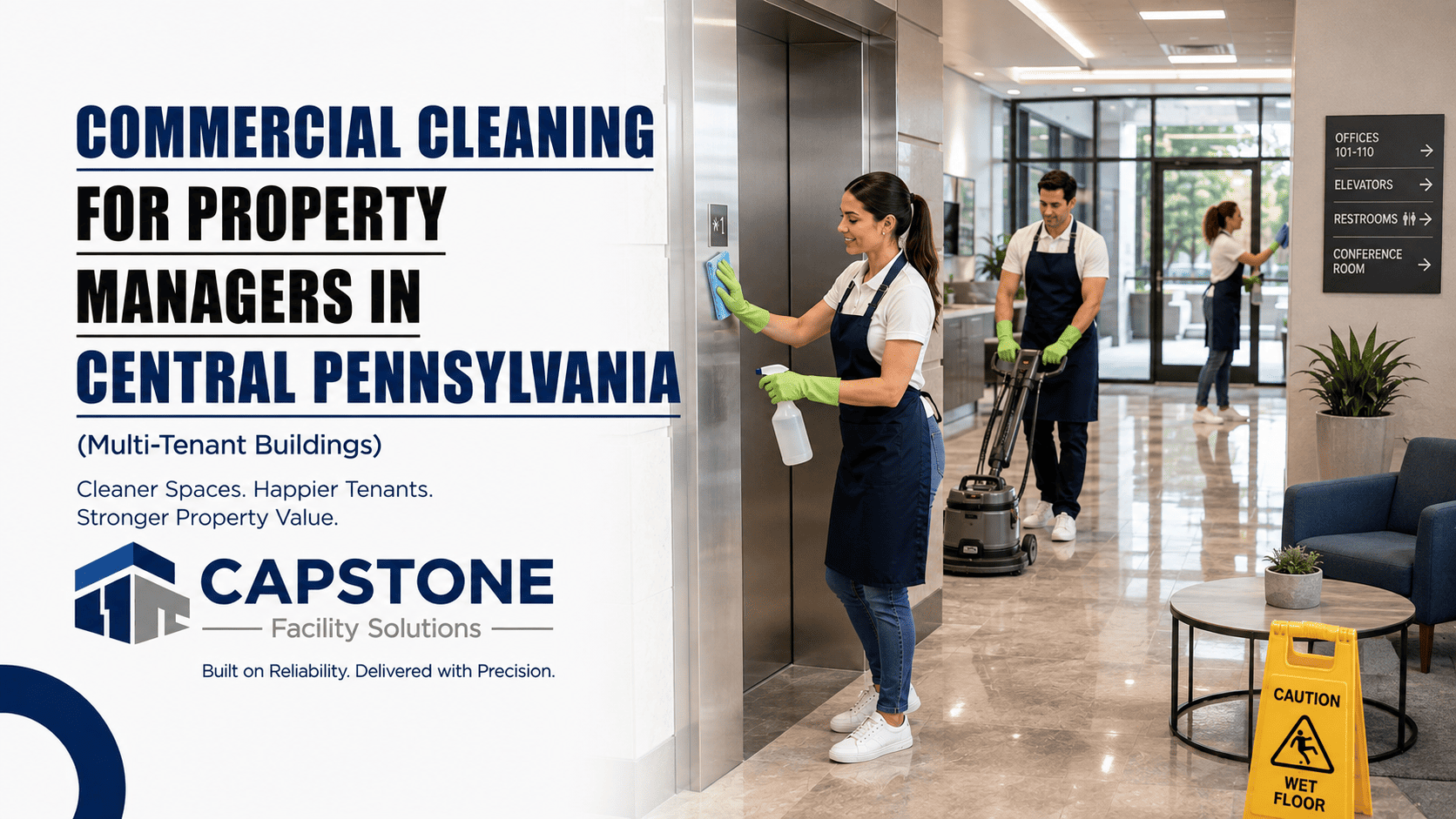
The lobby is the building’s business card. It is what a prospective tenant sees on a leasing tour and what every existing tenant walks through twice a day. A common area program starts here:
In Central PA winters, entryway salt tracking is the single fastest way for a lobby floor to look neglected. Buildings with heavy winter traffic often move to twice-daily entry attention from December through March.
These are the spaces tenants notice only when they look bad. A consistent program covers:
Stairwells are the most commonly skipped area in multi-tenant buildings and the one most likely to appear in a fire-inspection note or a tenant complaint about debris.
Shared restrooms generate more tenant complaints than every other common area combined, because they serve dozens of people who have no ownership of the space. A thorough program includes:
The variable that matters most here is not thoroughness but frequency of restocking. An empty towel dispenser at 2pm generates a complaint no matter how well the restroom was cleaned at 6am — which is why higher-occupancy buildings usually add a day porter (see Section 6).
Depending on how leases are written, tenant suites may be cleaned under the building program, contracted separately by each tenant, or excluded entirely. A good vendor can handle all three arrangements in one building:
Being able to offer tenants a direct cleaning option through the same vendor is a genuine amenity — it saves the tenant a procurement exercise and saves the property manager from coordinating multiple unfamiliar crews with building access.
Vacancy is where cleaning directly affects revenue, because a suite shows better and leases faster when it is genuinely clean. Turnover work typically includes:
That last item overlaps with post-construction cleaning, which is a distinct scope involving construction dust that ordinary cleaning will not remove.
For buildings with heavy daytime traffic, nightly cleaning alone leaves an eight-hour gap where the building slowly degrades in full view of tenants. A day porter closes it:
A day porter is also, practically speaking, a second set of eyes on the property. Burned-out lights, leaks, damaged fixtures, and propped doors get reported the same day instead of surfacing as a tenant complaint a week later.
Common area flooring takes the most traffic in the building and the least individual ownership. Beyond nightly maintenance, a schedule of commercial floor care protects the asset:
Putting these on a published annual calendar rather than handling them reactively makes them easier to budget and easier to justify in CAM reconciliation.
This is where cleaning contracts actually succeed or fail. Before signing, confirm the vendor can provide:
If a vendor hesitates on the COI or cannot describe their key control process, that is the answer.
Property managers rarely have one building. Consolidating cleaning across a portfolio produces real operational savings:
The practical approach is to start with one building, confirm the vendor performs, then expand. Any vendor worth using will accept that structure rather than pushing for the whole portfolio on day one.
Renewal decisions are rarely made on one dramatic factor. They accumulate — a lobby that always looks tired, restrooms that are unreliable in the afternoon, a stairwell nobody has swept in a month. None of it individually causes a tenant to leave. Together it builds the sense that the building is not well run.
Cleaning is one of the few building expenses where tenants see the result every single day. It is also among the most cost-effective retention tools available, because the cost of a consistent common area program is small against the cost of losing a tenant and carrying a vacant suite through a leasing cycle.
Clean common areas also support safety — dry entries, clear stairwells, and maintained flooring reduce slip and trip risk in exactly the shared spaces where liability sits with ownership.
Capstone Facility Solutions provides professional commercial cleaning services throughout Central Pennsylvania, including office buildings, professional plazas, and multi-tenant commercial properties in Harrisburg, Hershey, Lebanon, Palmyra, and surrounding communities.
We are locally owned, not a franchise, so the person who quotes your building is the person you call when something needs attention. Every team member is background-checked and trained before working in an occupied property. We carry full general liability and workers’ compensation coverage and provide certificates of insurance on request. We build a written scope of work for each building rather than a generic checklist, and we scale across a portfolio at consistent standards.
Every program is backed by our 100% satisfaction guarantee, with no long-term contract required. See our full janitorial services programs, or review how commercial cleaning is priced in Central PA.
Common area cleaning typically covers lobbies and entries, corridors, elevator cabs and lobbies, stairwells, shared restrooms, breakrooms or amenity spaces, and trash removal, plus periodic floor care and high dusting.
Most multi-tenant buildings use nightly cleaning for lobbies, corridors, and restrooms, weekly detail work on stairwells and glass, monthly high dusting, and quarterly or annual floor refinishing and carpet extraction. High-occupancy buildings usually add a day porter during business hours.
Yes. Portfolio-wide programs give property managers one vendor relationship, one insurance file, consistent standards across every property, and a single escalation path. Most managers start with one building and expand once the vendor is proven.
Yes. Turnover cleaning includes a full deep clean of the vacated suite, debris removal, carpet extraction or floor refinishing, restroom and kitchenette deep cleaning, and interior window cleaning so the space shows well to prospective tenants.
Yes. Capstone Facility Solutions carries general liability and workers’ compensation coverage and provides certificates of insurance naming the required entities as additional insured.
Through a documented key and access control procedure covering keys, fobs, alarm codes, and staff changes. All team members are background-checked before working in an occupied property.
A day porter works during business hours on restroom restocking, lobby touch-ups, spill response, and trash pulls. Buildings with heavy daytime traffic, food service tenants, or frequent leasing tours benefit most.
Every property is different — traffic patterns, tenant mix, flooring, and vacancy rate all change what the right scope looks like. Pricing should come from a walkthrough, not a template.
Call Capstone Facility Solutions at 717-298-7157 to schedule a free on-site assessment and receive a written scope and quote for your building or portfolio.
Tell us about your facility and we will send a custom, no-obligation price — usually within a day.